Quick Nav
- Four measures agreed first
- Rooms already in use
- Form and working Gaelic
- The ensemble that still meets
- Light capture in production
- The village copy
Four Measures That Have to Be Agreed First
Cultural project evaluation in the Gaelic arts is the systematic measurement of artistic achievement, active Gaelic-language use, practitioner development, and enduring community legacy.
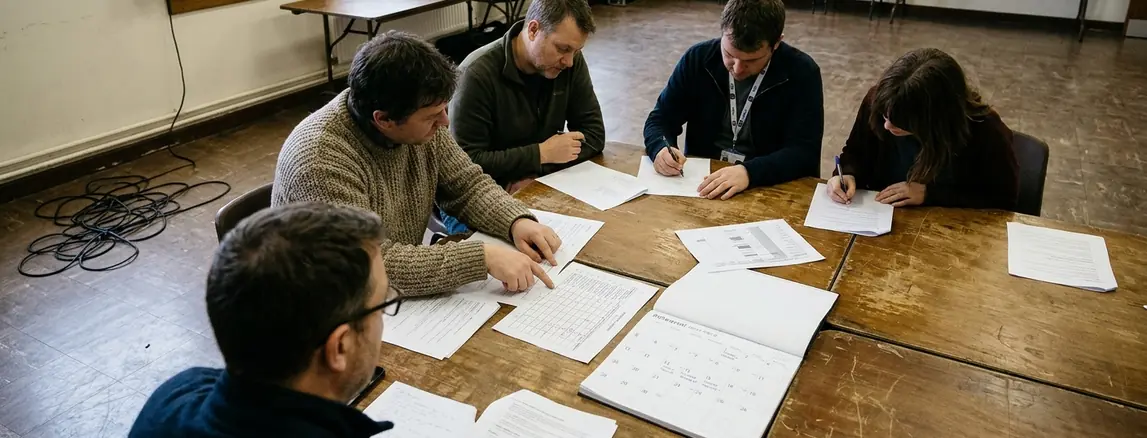
Artists, Gaelic-speaking participants, and community representatives agree what success would look like across all four dimensions, and they assign an evidence source and a collection responsibility to each one. I set that agreement down as a single matrix 21 to 42 days before the first rehearsal, workshop, or residency session: four rows, each with an intended outcome, a baseline, an evidence source, a collection date, and a named person.
Headcounts at the door do not carry this work. Effective evaluation has to show how an initiative strengthens the living linguistic and creative fabric of the participating community. Tickets issued, admissions recorded, and identifiable repeat participation are different measures. Folding them into one figure about unique beneficiaries erases the difference between a seat sold, a person through the door, and a person who returned.
The four pillars sit as one structural model, so a director can see the whole commission before the first call.
| Pillar | Baseline question | Delivery evidence | Follow-up evidence |
|---|---|---|---|
| Artistic Achievement | What repertoire, techniques, and creative ambitions are already present? | Peer responses, work samples, and a dated creative decision log | Reflection 7 to 14 days after the final presentation |
| Linguistic Vitality | How do participants describe speaking, understanding, reading, and writing, and where do they actually use Gaelic? | Consented observation of rehearsal, teaching, and backstage language, kept apart from programme visibility | Task-specific confidence questions repeated at entry, midpoint, and close |
| Artist Progression | Which performance, composition, technical, administrative, and facilitation skills are already in the company? | Identifiable changes in responsibility, tied to work samples, credits, contracts, or corroborated accounts | Skills reflection at 28 to 42 days; later commissions, employment, or collaborations at 6 to 12 months |
| Community Benefit | What local gatherings, facilitators, spaces, and organising capacity already exist? | Shared activity, intergenerational exchange, and who controls resources during delivery | Checks at 3 to 6 months and 9 to 12 months on meetings, rehearsals, and volunteer-led activity |
Consider a youth ensemble already meeting in a cultural hub that hosts a weekly ceilidh. Artistic Achievement asks which sets the players already hold. Linguistic Vitality asks who gives the teaching cue in Gaelic. Artist Progression asks whether a young musician leaves able to lead. Community Benefit asks whether that weekly gathering still meets after the visiting director goes home. One full house answers none of those four questions on its own.
Language Profiles and the Rooms Already in Use
Baseline work records the pre-existing state of Gaelic arts activity and language confidence before rehearsals, workshops, or commissions begin. Three inventories come first: participant language profiles, existing artistic practice, and the resources already available locally.
Participants describe competence and confidence separately. The note then records the settings in which they actually use the language. Speaking, understanding, reading, and writing stay in separate fields. Confidence is asked for rehearsal, informal conversation, public performance, and technical discussion. A single general fluency score would hide the singer who can hold a verse in public and still hesitate when the lighting cue has to be given in Gaelic.
Self-description stays apart from observed use. For intergenerational exchange, the baseline records which age groups take part together and whether Gaelic passes between them during shared activities. The local map covers rehearsal rooms, instruments, recording equipment, transport, tutors, and local organisers. A starting skills inventory covers performance, composition, directing, sound, lighting, production administration, and Gaelic-language facilitation.
Initial profiles are collected 14 to 28 days before delivery. Changes are confirmed in the first session, while memory of ordinary practice is still close and the company has not yet rewritten its habits around the new timetable.
A touring house against a long island stay
Baseline criteria shift with local demographic reality. For a touring national theatre production, the pre-arrival file documents each venue’s existing Gaelic programming, local partner relationships, audience language profile, and planned learning activity. The company arrives, plays, and leaves. Without that venue portrait, a single Gaelic-language night can be written up as if it founded a tradition the house already carried.
A multi-month island residency asks for a different starting page. The baseline establishes the existing frequency of local arts gatherings, the availability of Gaelic-speaking facilitators, participant travel requirements, and access to working spaces. The binding constraints are often the ferry, the hall diary, and who can stay after dark.
Both belong to Gaelic heritage work inside the performing arts. They do not share a starting measure. The touring file is a sequence of venue portraits. The residency file is one place, read across weeks, with the same people likely to appear in more than one session.
Peer Notes on Form, and Gaelic in the Working Room
Aesthetic rigor, creative risk, and innovation in traditional and contemporary Celtic forms become readable when the questions are fixed with practitioners before peer assessment is invited. The agreed questions cover how the work handles form, interprets tradition, takes creative risks, and develops its Gaelic expression. Reviewers connect each judgment to a particular scene, composition, design choice, or revision.
A structured peer response covers artistic intention, execution, relationship to Gaelic cultural material, experimentation, and revisions. Reviewers need relevant art-form expertise and Gaelic-language competence. A creative decision log records the date, the artistic problem, the change made, and the practitioners’ explanation. That log makes development visible past the finished night. Review points sit at the opening development stage, the production midpoint, and a reflection session 7 to 14 days after the final presentation.
Gaelic-language evidence breaks into programme visibility, rehearsal working language, and intergenerational use. Each describes a different cultural outcome. Bilingual signage, publicity, and programme notes record language displayed to an audience. Gaelic used for rehearsal instructions, creative discussion, youth teaching, backstage coordination, and informal exchange records the working medium. A separate note records whether Gaelic passes between age groups during shared activity. A foyer panel, a stage-management call, and a conversation between a grandparent and a learner at a workshop table are three facts.
Three Language Ledgers
Hold programme visibility, rehearsal working language, and intergenerational use in separate columns from the first observation. Each column answers a different question about how Gaelic heritage is carried in the commission.
A protocol for confidence across the commission
- At entry, record speaking, understanding, reading, and writing separately, and ask about confidence in rehearsal, informal conversation, public performance, and technical discussion.
- During delivery, run consented observation periods of 10 to 15 minutes at comparable stages. Note the task, speakers’ roles, language choices, and available language support.
- At midpoint and at close, repeat the task-specific confidence questions for learners and for fluent speakers.
- For audiences, record confidence engaging with a Gaelic performance apart from speaking ability, and record actual speaking practice only through an associated participatory activity.
- Hold the artistic and linguistic reflection 7 to 14 days after the final presentation, when the company can still point to a scene and a language choice.
Public planning language sits beside that internal log. The Bòrd na Gàidhlig national Gaelic language plan guidelines give public bodies a national frame for describing Gaelic use. A commission’s own notes still have to show whether Gaelic was the medium of rehearsal, youth teaching, and technical talk, or whether it appeared only in print.
Skills Gained, and the Ensemble That Still Meets
A progression record for artists, technical crew, and cultural administrators compares initial responsibilities with tasks each person can subsequently undertake. Reported development connects to a work sample, a credit, a contract, or a corroborated account. The change has to be identifiable: an assistant taking responsibility for a sound mix, a performer leading a Gaelic workshop, an administrator preparing a production budget independently. Cross-disciplinary collaboration and professional visibility belong in the same file, named rather than inferred.
Skills reflection is scheduled 28 to 42 days after completion. A second look, 6 to 12 months later, asks about subsequent commissions, employment, or collaborations. The later date is where a new credit can be checked against the skill the person claimed in the first reflection.
Lasting community benefit is a different clock. At 3 to 6 months, and again at 9 to 12 months after departure, the record asks whether local steering groups meet, youth ensembles rehearse, volunteers organise activity, and local participants control the resources left behind. The last touring performance marks completion of an output. The island ensemble’s dated rehearsal record months later is evidence of an enduring local structure.
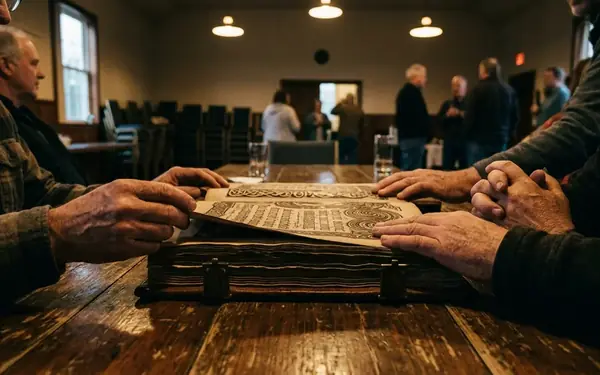
That split is already the habit of archival reading in the files of Pròiseact nan Ealan, the Scottish Gaelic Arts Agency, where documenting major cultural initiatives required both the immediate artistic output and the durable social infrastructure left in host communities. Commissioning correspondence, project reports, programmes, accounts, and community papers are read together. Major projects in the performing arts and in visual arts & literature leave different objects on the table: a score and a lighting plot for an international opera such as St Kilda: A European Opera, a manuscript and design record for An Leabhar Mòr. The reading rule does not change with the object.
For each archival claim, the note records the document title, creator, date, repository reference where available, and the passage that supports the claim. Agency project files are evidence to interrogate. Within that archive, a programme establishes a planned presentation; the claim holds for billing and intention, and it stops there. Dated minutes, rehearsal records, or subsequent correspondence can establish continuing local activity. A closing report’s aspirations alone do not demonstrate durable community infrastructure, so the researcher waits for dated evidence from after delivery before writing that the structure remained.
Light Capture While the Production Is Still Live
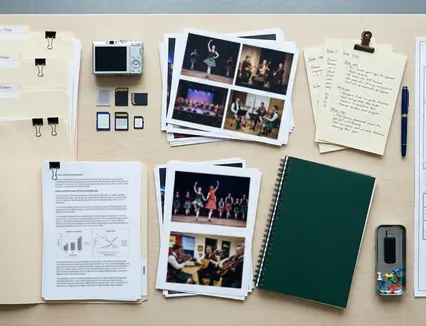
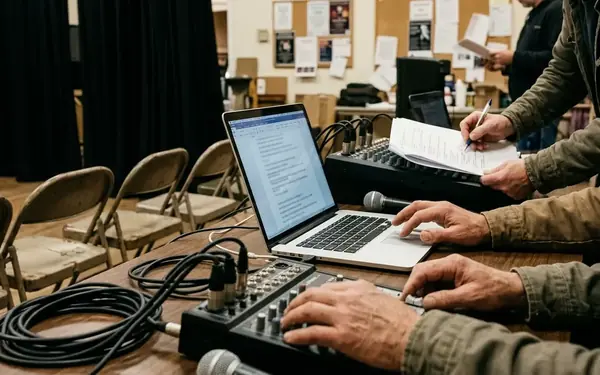
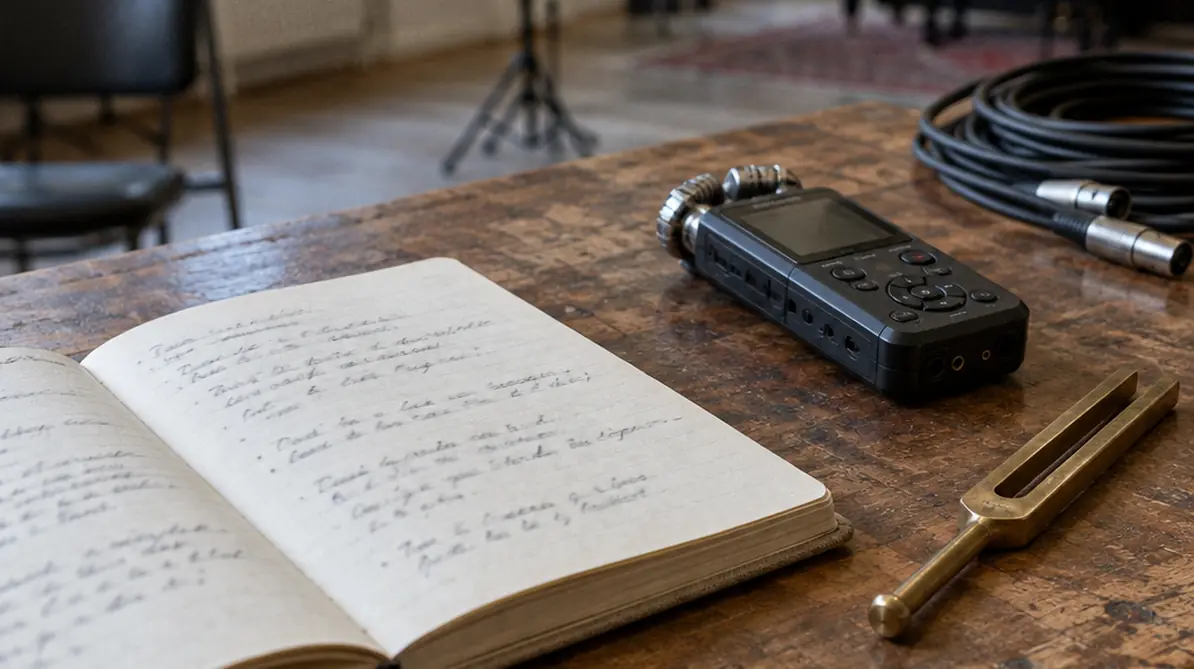
Proportionality scales evaluation rigor and administrative overhead to the financial scale, duration, and human capacity of the project. A named evaluation coordinator distributes small recording tasks among roles the production already carries. Evidence is chosen because it answers the agreed questions. Collection sits in rehearsal breaks, production meetings, and community gatherings, where a notebook and a short recording already belong to the room.
A short project carries a baseline, selected delivery observations, and a closing reflection. A multi-month commission adds a midpoint review and a scheduled legacy follow-up. The extra layer is justified by duration and by the people available to hold it, not by a wish for a thicker file.
After the Applause
A lengthy paper questionnaire handed out immediately after an emotionally significant performance interrupts the cultural experience and returns thin answers. Offer a brief invitation to contribute later. Audience or participant reflection belongs in a window of 2 to 7 days after the activity, away from the venue exit.
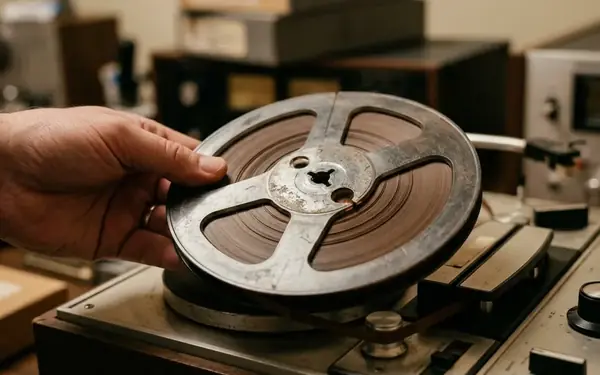
Woven capture keeps the evening intact. Artist audio diaries last 2 to 4 minutes after selected sessions. Three prompts are enough: an artistic decision, a language interaction, and a support need. Consent comes before any voice is recorded. The explanation covers who will hear the recordings, what will be quoted, where files will be held, and the agreed deletion or archival-review date.
Diary Length
Two to four minutes after a session holds one artistic decision, one language interaction, and one support need. The diary should finish before the next call on the sheet.
After a ceilidh or a community workshop, observational field notes are written at once. They name the activity, the opportunities to participate, the intergenerational interaction, and examples of Gaelic use. Where the question needs conversation, a focus group brings 4 to 8 participants together for 45 to 60 minutes, facilitated in Gaelic, English, or a combination the participants choose. The facilitator’s language follows the room. It does not set a test the room did not ask for.
The Funder’s Dossier and the Copy That Stays
Raw qualitative and quantitative evidence is organised under the four assessment dimensions, with a visible link from each conclusion to its supporting record. Recorded outputs, participant testimony, evaluator interpretation, and future intentions stay in separate bands. Every substantive outcome claim names the source underneath it.
The accountability dossier covers delivery, expenditure, outcomes, and unresolved questions. It includes the baseline comparison, collection dates, participation definitions, artistic assessments, language-use observations, practitioner progression, and the community follow-up schedule. Institutional grant-makers receive that dossier against the contractual deadline, with the unresolved questions left visible rather than smoothed into a success narrative.
The community version is prepared through bilingual discussion and an accessible archival summary. Contributors check quotations and mark sensitive material before either text leaves the draft table. An initial findings draft circulates 14 to 28 days after completion. A community review is held 28 to 42 days after completion. The revised account is issued within 42 to 56 days, aligned with those contractual reporting deadlines.
Ethical ownership means host communities retain access to the historical record of their own creative milestones. Preservation information attaches to each recording and document: title, date, creator, language, consent status, access conditions, and file format. Permission to preserve a recording is recorded separately from permission to publish it. Accessible copies go to an agreed local custodian at the moment of filing. A Scottish Gaelic community summary travels with the institutional submission, with an English version for wider access. Cultural hubs that hosted the work, a village hall or a city partner venue, keep that Gaelic text if the linguistic record is to remain theirs.
Local Custody
Place an accessible copy with the agreed local custodian in the same week the institutional filing goes out. The host community then holds the historical record of its own creative milestone, in the language of the work.