The Accessibility Shift from Community Halls to National Stages
Scottish Gaelic theatre has moved from performances shaped chiefly for local Gaelic-speaking communities toward productions that tour to audiences with mixed language knowledge. This shift spans twentieth-century community-hall traditions and touring productions of the late twentieth and early twenty-first centuries. Touring changes how creative teams approach audience comprehension. In the intimate setting of a village hall, shared linguistic and cultural assumptions allow for rapid, nuanced dialogue without external support. The audience and the performers occupy the same cultural space, relying on a shared vocabulary of idioms and historical references.
The transition to large-scale national venues introduces distinct logistical and artistic hurdles, including the need for a translation plan. On a national stage, the audience brings varying levels of Gaelic proficiency, from fluent speakers to those encountering the language for the first time. The production must bridge this gap without diluting the source material. A Gaelic touring production divides audience understanding among bilingual action, timed projected dialogue and cultural context supplied before the curtain.
For a touring production, the decision is made at the script-development stage. Successful legibility relies on integrating translation into script development. Before the first rehearsal, the script and design teams mark three separate needs. They identify information conveyed through action, speech requiring a surtitle, and background better placed in the programme. Productions developed under the umbrella of Pròiseact nan Ealan demonstrate this integrated approach. Accessibility becomes a structural component of the drama.
Embedding Translation Mechanics During Early Rehearsals
In early rehearsals, the playwright and director identify what a spectator must understand at each turn of the action. During the first 3–5 rehearsal days, the creative team marks plot-critical Gaelic lines. They test each against the action visible onstage before drafting explanatory English dialogue. This process embeds translation mechanics directly into the physical movement of the performers. The rehearsal room provides a place to test the limits of non-verbal communication.
Bilingual actors test whether a gesture, an exchanged object, a change of position or a brief English response establishes the necessary fact. Consider a scene involving a dispute over property. A bilingual character might answer a Gaelic instruction in English while carrying it out. The reply establishes the task for the non-speaking audience members. The Gaelic speaker retains the authority and emotional force of the exchange. English supports the scene's structure without replacing Scottish Gaelic as the language in which its emotional conflict is played.
Testing Physical Context Cues: When evaluating a scene's legibility, directors isolate the physical movement from the spoken text. If the exchange of a prop or a shift in posture conveys the character's intent, the team can eliminate the corresponding English surtitle, reducing visual clutter.
This physical theatre approach reduces the reliance on direct text translation. It demands rigorous discipline from the performers, who must synchronise their physical cues with the linguistic rhythm of the scene. The Scottish Gaelic dialogue remains the primary emotional vehicle. The actors carry the weight of the narrative through their vocal delivery and physical presence, while the English elements provide a structural scaffold. The integration of these elements requires a deep understanding of both languages and the cultural nuances they carry.
Synchronising Projected Text with Stage Action
The technical integration of surtitles requires treating the projected text as a core lighting and set design element. The translator reduces each cue to the information needed at that dramatic moment. Across 1–2 technical rehearsals, the production team checks projected text from the front, middle and rear of the seating area. They revise cues that appear during rapid movement or important silent reactions. The stage composition must accommodate the text without compromising the aesthetic vision of the production.
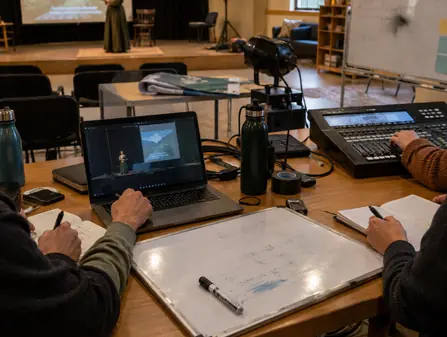
The director, operator, lighting designer and set designer test its position, contrast and timing together. Reading the text must allow spectators to return their visual focus to the actors' performances. Set each cue's length against the actual display width and the duration of the spoken line. A surtitle cannot preserve every association carried by a Gaelic idiom; it can identify the meaning the audience needs for the scene. Condense an idiom's dramatic meaning rather than forcing a word-for-word rendering onto an overcrowded slide.
Where archived production logs from St Kilda (Hiort) detail audience reception, the consensus highlights the importance of precise timing. The pacing of text projection dictates the audience's visual rhythm. If a cue lingers too long, it distracts from the stage action. If it flashes too briefly, it causes frustration. The operator must anticipate the actors' delivery, triggering the text a fraction of a second before the spoken line. This synchronisation lets viewers absorb the translation without breaking their engagement with the performance.
While this approach supports comprehension, its success relies heavily on the spatial dimensions of the specific venue. Sightlines vary drastically between a modern auditorium and a converted historical space. The technical team must adapt the projection angles and font sizes for each location on the tour. The setup ensures the text sits within the audience's peripheral vision while they watch the performers.
Offloading Cognitive Demand Before the Curtain Rises
The team separates knowledge needed before the curtain from information the play should reveal itself. Prepare the contextual note 7–14 days before opening, then check it against the near-final script so it does not disclose a revised scene's revelation. A short programme note establishes a setting, a social relationship or the force of an expression. The performers then disclose the conflict and its outcome. This division of labour between the printed page and the live stage is crucial for maintaining dramatic tension.
Providing cultural, historical, and linguistic context in printed programme notes reduces the cognitive load on the audience during the live performance. A note might explain that forms of address can signal kinship or social distance, or identify the historical setting of a dispute, without stating which character wins it. This pre-show framing equips the audience with the necessary tools to decode the onstage action. They enter the auditorium with a foundational understanding of the world they are about to witness.
Consider the integration of materials like Leabhar Mòr na Gàidhlig or themes from Na Mo Chuid Aodaich into the broader educational outreach of a production. These resources offer deep cultural background that cannot fit within the constraints of a live performance. By offloading this information to the programme or pre-show digital platforms accessible via iOS/Android devices, the creative team frees the script from heavy exposition. The narrative unfolds naturally, driven by character and conflict rather than the need to educate the audience.
Structuring Pre-Show Context: Limit programme notes to foundational cultural concepts and historical timelines. Avoid summarising the plot or detailing character arcs, as this diminishes the dramatic tension of the live performance.
The audience enters the auditorium prepared to engage with the emotional reality of the play. They understand the social hierarchy of the characters and the historical weight of the setting. This preparation allows them to focus on the actors' performances rather than struggling to parse unfamiliar cultural references in real-time.
Protecting the Core Identity of the Production
After the first 1–3 performances, the creative team reviews whether spectators need the screen to follow the plot. They assess whether the Gaelic-speaking actors still command the scene. Review moments when a new surtitle competes with a gesture, entrance or change in lighting; adjust the cue or staging at that point rather than adding more explanatory text. This iterative process ensures that the accessibility tools remain subordinate to the artistic vision of the production.
The boundary is reached when spectators follow a Gaelic character's decisive gesture through the surtitle screen instead of watching the actor. The resulting edits protect the play's Gaelic voice while making essential dramatic information reachable beyond fluent speakers. Accessibility tools must serve the drama. They provide a bridge into the world of the play, but they must never obscure the performances they are designed to illuminate. The physical presence of the actors and the acoustic resonance of the spoken Gaelic must remain the focal point of the theatrical experience.
The ongoing tension between preserving the purity of a Gaelic script and ensuring the production's viability requires constant calibration. Every added surtitle and every line of explanatory English dialogue shifts the linguistic balance of the performance. The creative team must weigh the necessity of comprehension against the risk of diluting the cultural authenticity of the work.
If the projected English carries the conflict more powerfully than the spoken Gaelic, what language now defines the production?