Sabhal Mòr Ostaig as a Living Gaelic Arts Campus: A Case Study in Place-Based Culture
Sabhal Mòr Ostaig offers a durable lesson for Gaelic cultural planning: language vitality grows when people need Gaelic to make something together. On its Isle of Skye campus, teaching sits alongside rehearsal, recording, performance and broadcasting. Students encounter the language as a working medium, while artists gain access to a Gaelic-speaking creative environment.
The model developed in stages. Sabhal Mòr Ostaig was founded in 1973, began teaching in converted farm steadings in 1974 and introduced its first full-time course in 1983. Purpose-built expansion between 1998 and 2008 brought educational, performance and creative-industry functions onto the same campus. That sequence turned a teaching base into a place where Gaelic work could be conceived, made and presented.
Gaelic Lives Through Artistic Production
Language preservation reaches a practical limit when the language remains solely an object of study. Vocabulary can be taught, grammar examined and literature read closely, yet speakers still need situations that demand immediate choices: how to phrase a stage direction, question an edit, introduce a song or explain an image to an audience.
Artistic production creates those situations. It asks learners to move from prepared exercises into collaborative speech, where meaning matters because the group has a deadline and a public outcome. The resulting Gaelic may be hesitant or uneven. It is also purposeful.
Sabhal Mòr Ostaig developed Gaelic as a language of work through three connected functions. The campus acts as a classroom, providing structured Gaelic-medium study. It acts as a studio, giving writers, musicians, broadcasters and visual artists room to produce. It acts as a venue, placing finished and developing work before an audience.
Each function strengthens the other two. A lecture can supply historical or linguistic context for a creative project. Studio activity turns that material into writing, recorded sound, screen work or visual art. A presentation then requires participants to speak about the work, answer questions and hear how an audience receives it.
This circulation matters more than the presence of any single facility. A performance hall without sustained Gaelic use remains a building. A course without opportunities for public expression keeps much of its language inside the timetable. When teaching, making and presentation share a place, learners can apply Gaelic before the momentum of a class has faded.
The Working-Language Test
A Gaelic hub should be judged by what participants must accomplish through the language. Completing an edit, rehearsing a scene or recording an introduction provides stronger evidence of active use than attendance alone.
Sabhal Mòr Ostaig succeeds as a place-based arts hub because it links acquisition with application. The campus gives students and artists recurring reasons to use Gaelic under real creative conditions.
From Seasonal Classes to a Gaelic Campus
The change did not arrive through one policy declaration. Institutional development moved step by step, beginning with short and seasonal teaching in the 1970s. Those courses established demand. Full-time study from 1983 then created a resident learning community whose needs extended beyond occasional tuition.
That distinction reshaped the institution. Seasonal learners can enter a course, attend scheduled sessions and leave when teaching ends. Full-time students inhabit the spaces between classes as well. They eat, plan, socialise and organise activity. Language use therefore spreads into informal campus life, where confidence often develops through repeated low-stakes exchanges.
Degree-level study and university partnership during the 1990s and 2000s added another requirement: Gaelic learners needed visible routes into professional and cultural practice. A language campus could no longer concentrate only on transmission. It also had to support the circumstances in which graduates might write, perform, teach, broadcast or produce work through Gaelic.
Location contributed to this development. Establishing the campus in a Gaelic-speaking part of Skye connected formal learning with community language use. Students could encounter Gaelic in at least three settings: timetabled teaching, everyday campus exchange and public creative activity. A performance, exhibition, recording or broadcast carried classroom knowledge into a social setting where other speakers could respond.
The comparison with classroom-only provision is revealing. A conventional course usually separates instruction from application. Learners practise a defined form, receive correction and proceed to the next task. A place-based campus preserves that disciplined study while adding less predictable demands. The learner may have to negotiate a rehearsal change, discuss the tone of a text or introduce a collaborator.
These exchanges do more than enlarge vocabulary. They establish Gaelic as a language in which professional judgement can be exercised. Participants disagree, revise, test ideas and settle decisions through it.
That principle aligns with the wider concern of Pròiseact nan Ealan: cultural vitality depends on opportunities to create ambitious work through Gaelic. Projects may travel to different stages and audiences, but they require an ecology of speakers, makers and production spaces. Sabhal Mòr Ostaig supplies that ecology in a concentrated, place-based form.
Rooms That Connect Teaching and Making
The physical campus followed programme needs. Teaching growth first required greater lecture and residential capacity. Arts and media activity later justified spaces for rehearsal, performance, exhibition, recording, production and broadcasting. A major teaching-campus expansion opened in 1998, followed in 2008 by a creative and cultural industries centre with professional production functions.
The order is significant. Buildings did not precede the programme as abstract cultural aspirations. Established activity generated demand for particular rooms and technical capacities. This gave each stage of development a clear operational purpose.
The Short Route from Seminar to Stage
Integrated space reduces the handoff between learning and production. A project can move from seminar discussion into rehearsal or studio work, then reach a campus presentation without transferring to a separate urban arts venue. Students retain contact with the language, the collaborators and the original context throughout that journey.
Consider a piece of Gaelic writing developed during a teaching session. In a fragmented model, the text might leave the course and wait for access to an external producer, recording room or performance slot. Each transfer requires new scheduling and explanation. On an integrated campus, the writer can test the piece aloud, receive a critique, revise it and present it within one connected environment.
This proximity also allows participants to observe work beyond their own course. A student who hears recording activity or attends an exhibition opening encounters possible uses of Gaelic that a syllabus description cannot convey. Professional practice becomes visible and ordinary.
Residencies as Structured Contact
Artist residencies make the connection between study and practice deliberate. Writers, musicians and visual artists work near students, with contact organised through workshops, critiques, demonstrations and public presentations. The artist brings a live project and a set of creative decisions into the learning environment.
The format differs from a guest lecture. A lecture can describe finished work retrospectively. A residency exposes process: uncertain drafts, technical constraints, revision and the choices behind a final form. Students contribute questions and material while the artist models how Gaelic operates within professional practice.
Public presentation completes the structure. It gives the residency a destination and places responsibility on participants to prepare work that can be heard, viewed or discussed beyond the workshop group. The audience also gains a route into campus activity.
The scale of Sabhal Mòr Ostaig requires a careful qualifier. Its development benefits from university-supported buildings, accommodation and specialist facilities within Sabhal Mòr Ostaig's institutional framework. A small community group cannot reproduce that estate. It can reproduce the functional overlap by scheduling language teaching, artistic production and public presentation in one consistently available room.
Copy the Overlap
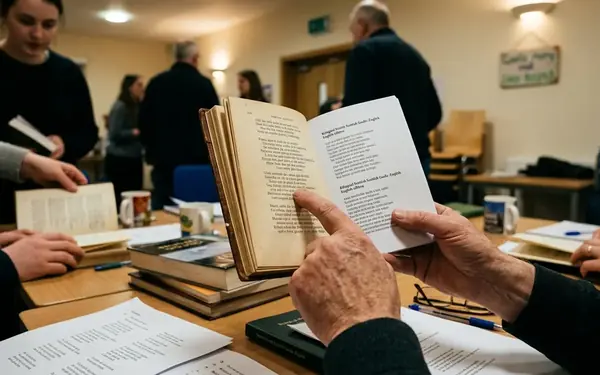
A village hall booked for the same evening each week shows how the principle scales down. The first hour is a Gaelic class. The second is rehearsal time for a local singer working on new settings of songs collected in the parish, with the learners asked to comment on the words. Once a month the doors open for a short public sharing, and whoever arrives hears the material discussed in Gaelic before it is performed. One room, the same speakers, three functions in sequence — the arrangement that gives the Skye campus its momentum.
Tracing the Campus Through Its Creative Work
The clearest institutional shift appears across 1974 to 2008. Seasonal teaching was joined by full-time study, degree pathways, artist residencies and permanent production infrastructure. Sabhal Mòr Ostaig consequently became a year-round anchor where Gaelic education and creative work could meet.
The effect should be assessed through activity attached directly to the campus. Relevant evidence includes residency records, course productions, studio credits, exhibitions, commissioned writing, broadcasts made through campus facilities and later work that documents a campus collaboration. These records show how space and programme translated into identifiable cultural output.
That method sets a useful boundary. Every Gaelic work made by a former student cannot be counted as a Sabhal Mòr Ostaig outcome. The connection is strongest where an archive identifies a workshop, commission, course project, studio session or campus presentation. This keeps the analysis focused on documented contribution rather than broad claims about the wider Gaelic revival.
Participation Gains a Public Form
On a seasonal teaching model, engagement tends to cluster around course dates. A year-round campus creates more points of entry. Students attend teaching, artists enter residencies, audiences come to presentations and production teams use media facilities. These groups overlap without becoming identical.
The qualitative change lies in the kind of participation available. A learner may begin as an audience member, contribute to a workshop and later present a course production. A practising artist can develop work while engaging with learners. Community speakers encounter new writing, music or visual art through events located in a Gaelic educational setting.
Contemporary output is central to this pattern. Campus-linked activity spans Gaelic writing, live music, recorded sound, radio production, screen work and visual art. The language enters forms shaped by current production practices, rather than remaining confined to historical display.
The campus therefore functions as cultural infrastructure. It holds relationships long enough for ideas to pass between education, artistic practice and public life. A single project may be modest, yet its participants gain experience of making decisions and presenting work through Gaelic. Repetition turns those experiences into a working environment.
Document the Connection
Record the workshop, commission, studio session or presentation that links an output to the hub. A dated project file and clear credits make the cultural contribution traceable later.
An Eight-Week Gaelic Zine Hub
A community can apply the same structure on a much smaller scale. The following case uses one library room, one fluent Gaelic writer-artist and a cohort of six to ten learners. The deliverable is precise: a 12-page Gaelic zine, accompanied by a public reading and an archived audio recording.
Step 1: Fix the Room and Rhythm
The organiser books an accessible library room for two fixed 90-minute sessions each week across eight weeks. The same room hosts language activity, drafting, editing and rehearsal. Consistency allows participants to treat it as a temporary production base rather than an occasional meeting space.
Step 2: Contract the Resident Artist
One fluent Gaelic writer-artist leads the residency. The brief combines artistic direction with facilitation of mixed-proficiency discussion. The artist must guide a finished publication, help learners express creative judgements in Gaelic and keep each role connected to the shared output.
Step 3: Recruit Around One Deliverable
The organiser recruits six to ten learners and states the outcome at the outset: the group will write, illustrate, edit and present a 12-page zine. Participants choose roles in writing, illustration and editing, while retaining opportunities to contribute across the production.
Step 4: Establish Gaelic Production Language
During weeks 1 and 2, the group agrees that planning, drafting, critique and rehearsal will take place in Gaelic. English remains available for external safety, access or supplier communication. Participants build a shared production glossary covering practical terms they will need during the residency, then record contributor consent and confirm responsibilities.
Step 5: Draft and Critique
Weeks 3 to 6 use the two weekly sessions for active production. Writers bring short drafts. Illustrators test images against the tone and space of each page. Editors identify unclear passages, check consistency and return questions to the group in Gaelic. The resident artist demonstrates a specific technique, then moves the discussion towards decisions the zine requires.
Each session ends with named tasks for the next meeting. By the close of week 6, every page has assigned text or artwork and the group has resolved the publication order.
Step 6: Edit and Rehearse
Week 7 is reserved for editing, layout and a Gaelic-language rehearsal. Participants read the text aloud to catch awkward phrasing and confirm who will present each section. The group also prepares the print master and checks contributor permissions against the final pages.
Step 7: Publish, Perform and Deposit
In week 8, the library room becomes the venue. The finished 12-page zine is available for the audience, and each participant reads or introduces an assigned contribution in Gaelic. The organiser records the reading.
Within five working days, the group deposits the print master, audio recording and contributor permissions in a local archive. The project now has all three parts of the Sabhal Mòr Ostaig model in miniature: the room supported language learning, the residency produced a new Gaelic work, and the public reading gave that work an audience.