Executive Summary: Visualizing the Bardic Tradition
Scottish Gaelic verse and contemporary visual arts now share gallery walls, carved stone surfaces, woven panels, and projected light. The intersection is neither casual nor decorative when handled well. Artists and curators treat the poem as two things at once: an authored or transmitted verbal work, and a material with weight, accent, and rhythm that can occupy physical space.
Three methodologies recur across the contemporary record. Typographic installation enlarges and fragments the written language; mixed media embeds text into stone, fabric, and digital surfaces; spatial design positions verse within rooms and landscapes so that viewers move through the poem rather than simply reading it.
One practical constraint shapes nearly every project. Gaelic poetic material commonly enters visual contexts through short excerpts rather than full long-form poems, because wall labels, projections, carved surfaces, and woven panels accommodate line fragments, refrains, place-names, or single stanzas more readily than complete texts.
The relevant period runs from the late 1980s through the mid-2020s, when Gaelic-language cultural programming, installation practice, public art, and digital documentation increasingly overlapped. The stakes for Celtic heritage preservation are real: a responsible project sequence normally includes text selection, permissions or community consent, Gaelic-language review, material testing, installation documentation, and bilingual interpretation planning before any public display.
Evolution from Textual to Spatial Representation
Gaelic poetry has long circulated through oral performance, song, recitation, manuscript copying, and printed collections. The voice came first, then the page. Contemporary visual work adds an entirely different register of surfaces: glass, stone, fabric, projected light, paper, sound stations, and outdoor signage.
The shift toward spatial presentation accelerated through the gallery culture of the 1990s onward. It is most useful to read this development not as a replacement for recitation but as an additional layer that sits alongside it.
Orthography as Visual Structure
From the 1990s to the 2020s, spatial treatments increasingly used Gaelic orthography itself as visual structure. Grave accents, lenited consonants marked with h, compound place-names, and long vowel sequences were enlarged, repeated, fragmented, or overlaid onto maps and landscape imagery. The written form of the language became texture without ceasing to be language.
A common workflow guards against subordination. Designers place the Gaelic line at primary visual scale and move English context to a label, handout, audio guide, or secondary panel, so the source language is not visually demoted in its own exhibition.
Enlarging Gaelic words across a wall without translation, speaker consultation, or accurate diacritics can reduce the language to visual atmosphere rather than preserving poetic meaning.
Methodologies in Typographic and Mixed Media
Artists usually begin by deciding which property of the poem will guide the work: the semantic meaning of the lines, the cadence of recitation, the visual form of the written Gaelic, or the geography it names. That first decision governs material and method.
Stone, Textile, and Projection
Stone-based works carry an unforgiving discipline. Gaelic text usually must be finalized before cutting begins, because corrections to accents, spacing, or lenition after carving can require recutting or replacing the surface entirely. The medium rewards short, certain fragments.
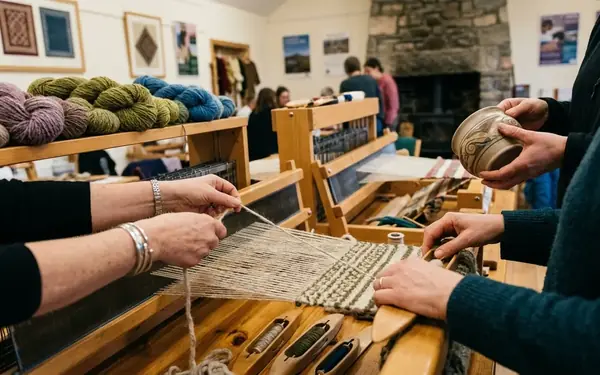
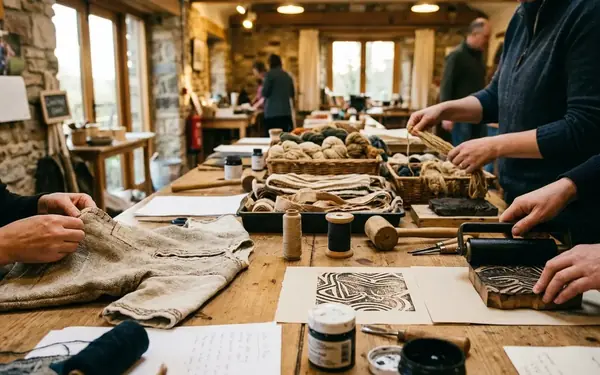
Textile offers more flexibility. Weavers and embroiderers embed Gaelic through woven letterforms, embroidered lines, printed cloth, or pattern systems keyed to syllable counts, repeated refrains, or stress patterns. The structure of the cloth can echo the structure of the verse.
Digital projection introduces time. It permits timed alternation between Gaelic text, English translation, and landscape image; exhibition loops in small gallery settings are commonly built in short cycles measured in minutes rather than as full-length readings. This is where context-dependent variation becomes clear: a carved outdoor work prioritizes durability and short fragments, while a digital gallery installation can support longer excerpts, audio recitation, timed translation, and layered imagery.
Pro Tip: Before fabrication, verify grave accents, apostrophes, hyphenation, capitalization of place-names, and line breaks against an approved Gaelic source. Typographic accuracy is not a finishing touch; it is the foundation of the work's legitimacy.
Conveying Phonetic Weight
Typography carries part of the burden that sound would otherwise carry. Scale, repetition, and spacing can suggest the cadence of recitation, and abstract visual interpretations of poetic meter and rhythm allow a viewer to sense structure even where they cannot hear it. The translation from ear to eye is partial by nature, which is precisely why the method demands precision.
Thematic Intersections of Ecology and Language
Gaelic eco-poetry and landscape visual art share a vocabulary of ground. Ecological readings develop by pairing the poem's place vocabulary with a material or site decision: peat, shore, machair, moor, mountain, river, crofting ground, or sea-route.
This matters because Gaelic landscape vocabulary often carries fine-grained distinctions that resist compression into single English equivalents, especially for landform, weather, grazing, shore, and seasonal conditions. A visual work that names the terrain in Gaelic preserves knowledge that a translated caption would flatten.
Environmental installations that use Gaelic poetry commonly rely on site-specific placement, field recordings, local consultation, and materials associated with the named terrain rather than generic Celtic motifs. The 2000s through the mid-2020s formed the most active window for this eco-linguistic practice, as language revitalization, land-use debate, climate concern, and community heritage documentation began appearing together in cultural commissions.
Operational examples are concrete. A team might project a place-based verse onto mapped terrain, carve a Gaelic place-name into stone at a coastal viewpoint, or align lines of poetry with archival images of crofting, fishing, peat-cutting, or seasonal movement.
Warning: Treating every Gaelic nature poem as timeless wilderness imagery can erase crofting history, land rights, migration, labour, and the specific local knowledge embedded in place vocabulary. The land in these poems is worked land, not empty scenery.
Limitations of Linguistic Translation in Visual Spaces
The honest assessment of this field weighs comprehension against artistic restraint. A viewer who reads no Gaelic may perceive letterform, rhythm, repetition, and placement. That same viewer will miss the sound features that carry much of the poem's force: slender and broad consonant contrasts, vowel length, internal echo, and the pull of a sung or spoken refrain.
Bilingual presentation adds genuine design pressure. Two languages require choices about hierarchy, type size, line spacing, label length, and whether the translation follows the Gaelic line by line or appears as a prose gloss. Each choice carries an aesthetic cost and a comprehension benefit, and the two rarely align cleanly.
Risk assessment should therefore check something specific: whether Gaelic is being presented as a living language with speakers, authors, dialects, and communities, rather than as an ornamental texture attached to landscape imagery.
Key Takeaway: A visually successful installation can still fail linguistically if Gaelic speakers are not involved in text verification, pronunciation guidance, or contextual interpretation. Beauty on the wall does not guarantee fidelity to the language.
Archival Practices for Multidisciplinary Works
Archiving begins before installation closes. The project team decides early what must survive once the physical arrangement, light conditions, soundscape, or outdoor setting disappears. Ephemeral works leave nothing behind unless someone plans for the record in advance.
The Minimum Archive Packet
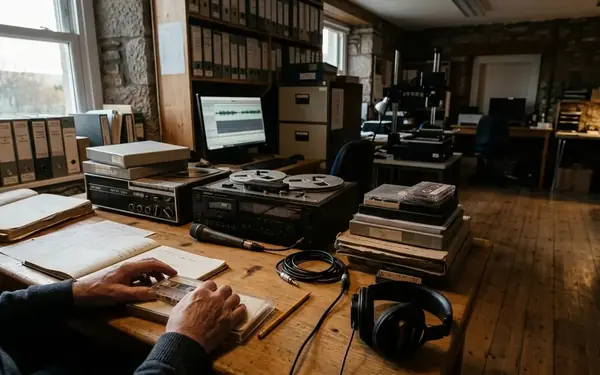
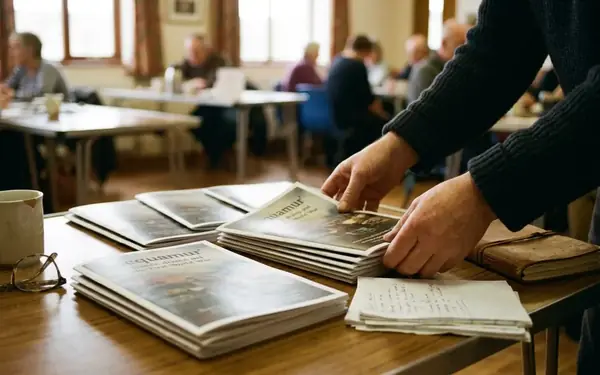
A defensible archive for an ephemeral Gaelic poetry installation should include the approved Gaelic text, a translation or synopsis, rights status, the artist statement, installation images, a floor plan or site coordinates, audio documentation where relevant, fabrication notes, and the deinstallation date. Each item answers a question a future researcher will eventually ask.
Documentation should capture both the artwork and its reading conditions: lighting level, projection timing, speaker placement, text scale, viewing distance, material surface, and whether the Gaelic was encountered silently, heard aloud, or both. The experience is part of the work.
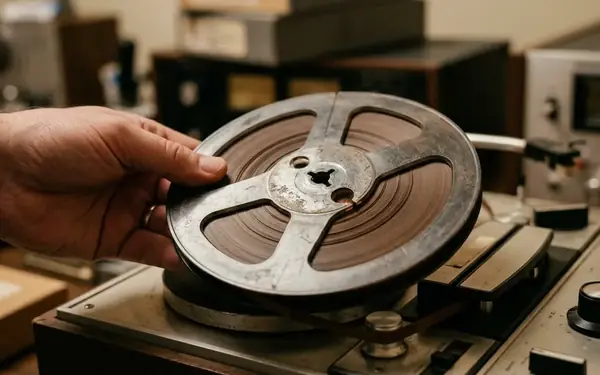
For digital preservation across the 2010s through the mid-2020s, common file categories include high-resolution still images, uncompressed or lightly compressed audio masters, video walkthroughs, PDF interpretive texts, and metadata identifying language, place, materials, contributors, and exhibition dates. These conventions sit comfortably alongside established archival standards for Scottish Gaelic manuscripts.
Permissions and Cultural Stewardship
Cultural agencies and archive teams typically separate public-facing records from restricted files when a poem, recording, community testimony, or location detail carries permissions that do not allow unrestricted online circulation. This is not bureaucratic caution; it reflects the reality that some material belongs to communities, not to the open web. Pròiseact nan Ealan and comparable bodies have modelled this distinction through long-running collaborative commissions where literary and visual practice meet.
A qualifier worth stating plainly: the protocols described here reflect recurring practice across this period rather than a single settled standard, and the right archival depth for any given Gaelic poetry installation depends on its scale, materials, rights situation, and the wishes of the community whose language it carries.
The future trajectory points toward richer digital archiving of multidisciplinary Celtic arts, where the poem, the object, the recording, and the reading conditions are preserved together. Outcomes demonstrate that when speakers, artists, and archivists share the work from the start, the visual arts become a vessel for the language rather than a substitute for it.