Executive Summary
Pròiseact nan Ealan treated digital media as an extension of Gaelic arts practice rather than a replacement for live transmission. The agency first documented stories, songs, trails, and youth drama in culturally consistent formats. Initiatives ran from 2006 through 2011, with later archival value arising from surviving project pages, media descriptions, and community records.
The digital portfolio combined at least four formats: GPS-triggered bilingual audio, downloadable or feed-delivered trail media, a Gaelic karaoke DVD, and short-drama video documentation. The core operational pattern was project-by-project commissioning. The agency paired cultural specialists with technologists, choirs, drama facilitators, or language-method practitioners according to the medium being produced.
The Challenge of Cultural Transmission
The agency’s decisions began from a practical transmission problem. Gaelic cultural knowledge was often tied to specific places, speakers, songs, and community settings. Many learners and younger participants lived at a distance from those anchors. The cultural problem appeared especially in island and west-coast heritage contexts, where access to sites, local guides, and Gaelic-speaking community expertise could depend on travel, season, and availability.
The agency’s digital work addressed three delivery settings: outdoor heritage interpretation, home or classroom language practice, and youth performance documentation. The relevant implementation window began with GPS heritage experimentation in May 2006 and extended through the launch of a digital heritage trail in October 2011.
Location Storytelling and GPS Integration
For A’ Coiseachd ann an Ceuman Choluim Chill, the project team chose a location-triggered walk because the story was place-dependent. Users were meant to encounter Gaelic and English audio at the physical sites themselves. The public community demonstration took place on 2006-05-25. The route used handheld iPaq-class PDA devices paired with Global Positioning System reception.
The interpretive design used geofenced trigger zones called “Magic Circles” to start bilingual audio when a walker entered a mapped area. The content design linked movement through the terrain with the heritage narrative rather than presenting all audio in a single linear menu. Preloading or installing audio assets onto the handheld units before the walk was required, because 2006 mobile connectivity was not a dependable delivery channel for outdoor heritage media.
Digital Heritage Trails and Inter-Governmental Initiatives
The later digital trail work moved from single-site handheld experimentation toward a distributed heritage route model. The project team coordinated with a cross-border Gaelic and Irish-language cultural initiative. The Sli Cholmcille digital heritage trail was launched on 2011-10-24. The historical frame included the year 563, when Columba is traditionally associated with the founding of the monastic settlement on Iona.
RSS protocols were used to distribute route-related digital materials such as maps and images. The delivery model suited trail content that could be broken into discrete items: location notes, image assets, map references, and short interpretive updates. The 2011 trail approach followed the 2006 location-storytelling experiment by retaining the idea that heritage interpretation should be tied to place, but it shifted from handheld-triggered audio toward web-accessible trail materials.
Interactive Language and Drama Platforms
The agency’s language and drama projects used digital media differently from the heritage trails. For Seinn thu Fhèin, the team selected a karaoke DVD format because learners could rehearse pronunciation and melody at their own pace. Seinn thu Fhèin was launched through programming in January 2009. The DVD format supported repeated playback, pause-and-repeat practice, and group singing in school, home, or community settings without requiring a live tutor at every session.
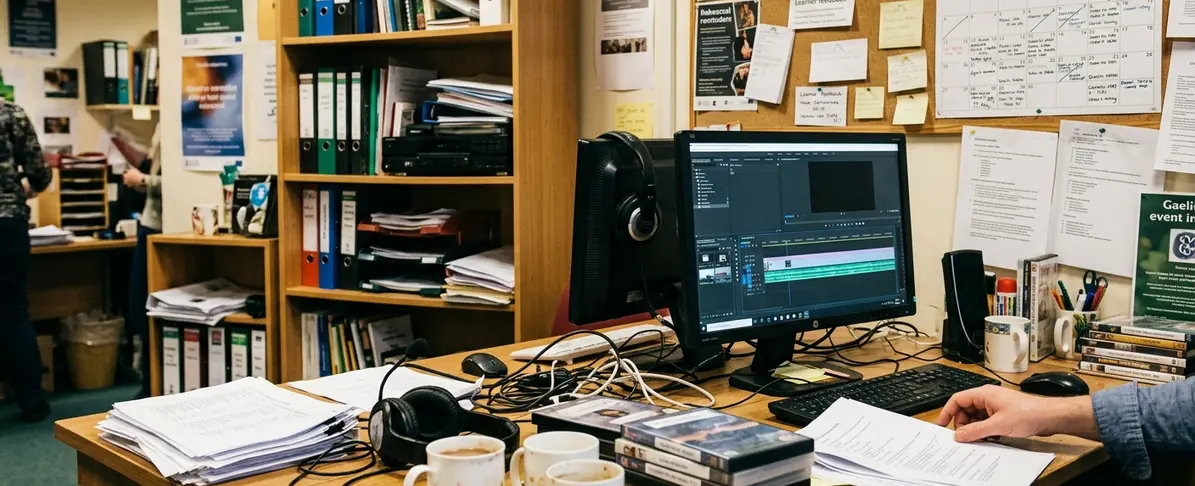
The language method referenced in the production was Ulpan, a structured approach associated with intensive spoken-language learning. The drama strand was developed with a Gaelic youth arts body and framed as a short-drama festival model. Weekly video blogs were used during the Mach 10 process to record development, participant activity, and project documentation on a social video platform common in the late 2000s.
Technological Scope and Hardware Limitations
The technical boundaries were set by the media environment of the period. In 2006, handheld PDAs could support preloaded audio and GPS polling, but they were not equivalent to later smartphones with real-time connectivity. These handheld units depended on external or integrated GPS reception and local device storage rather than continuous cloud delivery.
GPS accuracy in the mid-2000s was adequate for outdoor walking zones but could drift enough to make very small trigger areas unreliable, especially near buildings, steep terrain, tree cover, or poor satellite visibility. The “Magic Circle” model reduced precision risk by using broader geofenced areas rather than requiring users to stand on a single exact point. RSS in the 2011 trail context was appropriate for syndicating maps, images, and short updates, not for delivering heavy multimedia packages without separate hosting arrangements.
Late-2000s social video documentation was useful for visibility and process records, but compression, account dependency, and platform redesigns could affect long-term archival stability. A room-scale oral-history installation would not inherit the same evidence base as the 2006 walking-trail model, because GPS-triggered audio was designed around outdoor movement and broad geofenced zones.
Project Outcomes and Cultural Impact
The outcomes were strongest where the digital layer served an existing cultural practice: walking a heritage landscape, singing in Gaelic, rehearsing drama, or presenting work through community arts programming. The heritage projects produced documented models for bilingual place-based interpretation between 2006-05-25 and 2011-10-24. The karaoke DVD linked Gaelic song, learner repetition, and community choir participation through a physical digital medium available from January 2009.
The short-drama strand used a non-competitive youth engagement structure, emphasizing participation, production process, and Gaelic-language performance rather than ranking entrants. Digital documentation supported later archival access by preserving project descriptions, launch records, and process media connected to Gaelic arts practice. Festival and community arts settings gave the digital outputs public circulation beyond classroom or archive-only use.