Quick Nav
- Stornoway, 1977, and the classroom shortage
- English-dominant primaries and the missing early reader
- Two commissioning tracks for picture and word
- Shared colour plates and uneven orders
- What surviving copies can show about classrooms
- A sixteen-week commission from audit to delivery
Stornoway, 1977, and the classroom shortage
I set the foundation date, 1977, against the shortage the Western Isles bilingual education initiative made impossible to postpone. The operational base was Stornoway on Lewis. Fluent Gaelic-speaking schoolchildren needed contemporary reading material in the language they already spoke. Inherited religious texts and older literary print did not meet that classroom need.
Educational relevance created demand. Shared illustrated-book production spread the cost of colour origination across more than one edition. Those two facts help explain the early publishing model. Acair held a place in a small-readership market because commissioning followed what teachers could use, and because colour artwork could be manufactured with partners rather than priced as a one-language luxury.
The years 1977–1985 join the press's establishment to a later institutional marker: Gaelic-medium primary units opened in Glasgow and in Inverness in 1985. Survival in the founding decade is not explained by a national school system that had not yet taken that shape. It is explained by a local publishing response to a local reading gap, with a list that could later travel toward mainland units as those units appeared.
Three components organise the output. Classroom-led commissioning fixed reading stage before a manuscript was accepted. Shared illustrated-book production let colour artwork travel while language-specific text changed. The list combined local creative work with translated material, so Hebridean settings and imported picture sequences could both reach the same age bands.
Keep the Terms Apart
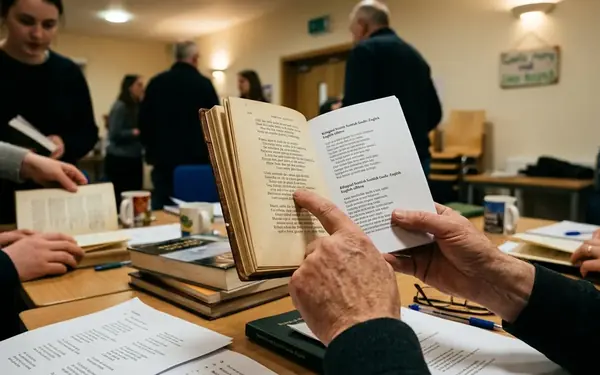
A bilingual volume carries two languages inside a single publication. A co-edition shares production assets across separate language editions. Editorial notes and cost sheets have to name which arrangement is in play, because pedagogy and plate planning diverge the moment the second language is either bound into the same book or printed as its own edition.
Island visual identity and translation adaptations sat on the same list without being the same editorial task. A croft interior drawn for a Lewis or Harris setting carries local reference. A translated picture book borrows an existing visual sequence and asks Gaelic wording to fit it. Both served youth publishing. Only the second depends on a co-edition structure.
English-dominant primaries and the missing early reader
Before the late 1970s, primary pupils in the Outer Hebrides met school almost entirely through English. Gaelic print culture was not absent. What early childhood lacked was contemporary reading matched to children learning to read. Religious texts and traditional folklore remained available. Their register, length, and assumed knowledge sat poorly beside the first years of literacy.
The founding window for that shortage is 1977–1979. Mainland Gaelic-medium expansion belongs to 1985 and after. Folding those dates together turns a Stornoway classroom emergency into a system that was still being built.
Editorial planning had to hold two child readers in view at once. One already spoke Gaelic at home. Lewis, Harris, North Uist, South Uist, and Barra supplied distinct linguistic and cultural reference points, and consistency across a list did not require those differences to be erased. The other child was acquiring Gaelic through school, including in mainland units that were still thin in the founding years. A single vocabulary list could not serve both without attention to reading stage, sentence length, recurrence of new words, and the relationship between a picture and a word not yet decoded.
The cost trap sat inside that pedagogical one. A short illustrated edition still incurs origination, printing setup, and binding. Those costs spread across fewer saleable copies than they would in a larger edition. A high cover price then narrows what local families will take home. The press could not price a four-colour picture book as if the market were a mass English-language list.
Books for fluent island children and books for learners in emerging mainland units therefore had to be commissioned as related but separate briefs. The same shoreline might appear in both. The sentence load, the recurrence of new words, and the amount of context a picture was asked to carry would not match. That distinction belongs in the commissioning file, not in a later marketing note.
Two commissioning tracks for picture and word
Commissioning analysis holds to two tracks. They are assessed by different tests.
Original work, language and setting together
For original Gaelic work, language, setting, and image develop together. A manuscript rooted in Hebridean life has to be readable at the target stage and visually specific enough that a child recognises the world of the page. Useful test subjects are concrete: croft buildings, shorelines, boats, domestic interiors, locally recognizable working landscapes. The Atlantic edge at St Kilda (Hiort) belongs in that geographic range as a remote reference, not as a substitute for the lived townships of Lewis or the Uists.
A historically grounded account of a particular commission needs dated title pages, illustration credits, translator credits, or production correspondence. Without those documents, the defensible description is the editorial sequence itself: manuscript selection, language editing, illustration briefing, then a proof of how text and image occupy the page. Teachers and community storytellers can supply register and local reference. Professional visual artists can hold the page to the production standard families already met in English-language picture books. The pairing is a method. A named pairing is a credit line, and it should be cited only when the credit line exists.
Translated sequences, wording fitted to existing art
Translated illustrated titles reverse the order of decisions. Pictures, page turns, and character actions already exist. Gaelic wording has to fit that sequence and that page design. Assessment compares speech register, idiom, line breaks, and text expansion against the source edition. A line that sits cleanly in the source may overrun once it is rendered in Gaelic. Lettering inside the illustration is language-dependent. So are captions. Both have to be identified before any plate is treated as shareable.
Illustration can establish characters, actions, and settings before a child decodes every word. That is a sequencing fact about picture books for early readers. It is not a share of comprehension that can be stated as a percentage. No such figure is defensible from the material in hand, and none should be used to justify cutting text or inflating art costs.
The shift away from text-heavy traditional tales, then, is best described as a change in how comprehension is staged across the opening, not as a measured split between word and image. The picture leads. The sentence confirms. Vocabulary recurs. A developing reader meets the island or the borrowed story at a pace the page can support.
Shared colour plates and uneven orders
Co-edition economics follow a production sequence.
Partners agree format, page extent, and artwork. The printer combines compatible quantities for shared colour production, then changes language-specific text between editions. In an appropriately prepared file, CMYK does the separating work: cyan, magenta, and yellow carry the shared picture, and black carries the words that must change. Captions, lettering inside illustrations, title pages, and cover text are language-dependent. Leave any of them sitting in the colour art and the shared plate is no longer shared.
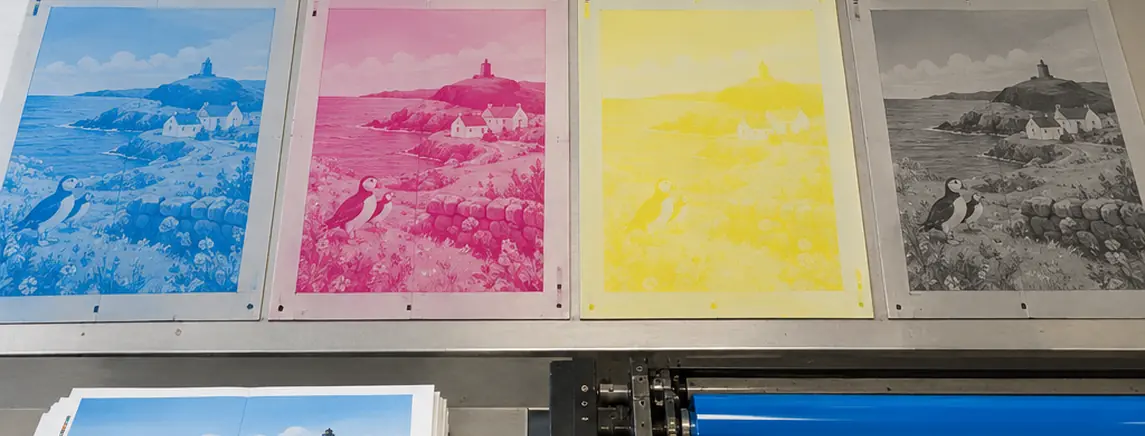
The production saving concerns shared origination and press setup. Translation, language editing, some plate changes, binding, and freight remain edition-specific or quantity-dependent. A combined run that is three times a single-language quantity does not, by itself, establish that unit cost halves. A defensible comparison uses dated printer quotations with identical specifications, together with purchase orders and reprint records. Assumed reductions are not evidence.
Quote Identical Specs
Ask the printer for two quotations on the same format, extent, paper, and binding: one standalone Gaelic edition, and one co-edition in which only the black plate changes. The Gaelic co-edition cost split is then visible on the page: shared colour artwork on one side, edition-specific text, rights, editing, and delivery on the other.
Manufacturing and distribution are separate ledgers. A classroom order, a library order, and a bookshop sale produce different quantities, discounts, and patterns of demand. Where Gaelic-medium classrooms could place institutional orders, those orders gave a title a floor of committed copies. That floor is why a risky creative title could be contemplated. School purchasing can support production. Changing education budgets make institutional demand an insecure basis for assuming that every new title or reprint will recover its costs. The Stornoway classroom-order boundary is plain: a 1977 educational publishing mission records a purpose. It is not evidence of guaranteed purchases or of profitable reprints.
Discoverability outside the Highlands and Islands is often narrated as weak trade stocking, or as misclassification into specialist reference. National evidence of retail misclassification or poor stocking is not supplied in the record used here. That claim needs bookseller records or a documented stock audit before it can be treated as established. What can be planned without that audit is the split itself: institutional supply as one channel, general trade as another, with no assumption that a shop shelf will do the work of a school order.
Issued books leave an archival trace independent of shop classification. Acair books held in the National Library of Scotland catalogue fix titles, dates, and editions in a public record. Catalogue presence shows that a book was published and preserved. It does not show how many classrooms received a set, or at what discount.
What surviving copies can show about classrooms
Publishing outputs and educational outcomes have to be counted apart.
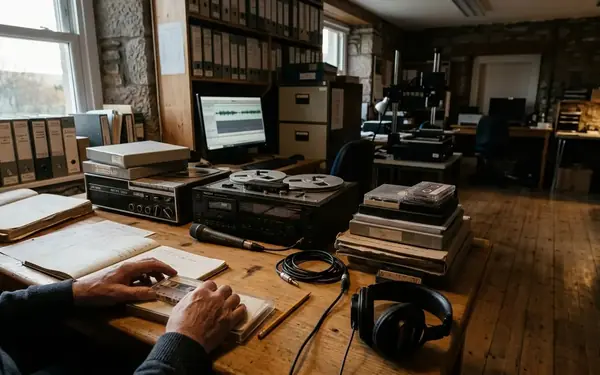
Dated editions and surviving classroom copies can demonstrate that illustrated Gaelic books became available. A bounded historical study compares surviving material from 1977–1985 with classroom collections from 1985–1995. Useful evidence includes accession dates, classroom-set quantities, borrowing records, reprint dates, and interviews that name particular books. Where a library accession date and a classroom-set quantity point at the same title, use is no longer a guess.
School inventories and teacher testimony can establish how a book was used. Claims about improved literacy, confidence, or family language use require additional evidence. Contemporary Gaelic print, and island imagery a child could recognise, made the language visible as a medium of the present rather than only of inherited texts. That visibility is an output of design, commissioning, and distribution. It becomes an outcome when a dated inventory, a borrowing record, or a named interview connects a specific book to a specific classroom or household practice.
Name the Copy
An impact note should name the book, the year, and the evidence type: accession, classroom-set quantity, borrowing record, reprint, or interview. A general claim that early readers reshaped Gaelic-medium classrooms stays qualitative until one of those records is attached.
The classroom change that the surviving objects can support is a change in provision. Improvised teacher-made photocopies gave way, where sets were purchased, to durable illustrated books and graded reading material produced to a trade standard. Durability and illustration are properties of the object. They can be observed on the copy. What a child felt on seeing an island landscape in a well-printed book is a further question, and it needs testimony tied to that copy.
Family literacy is a distinct access problem, and the format matters. A bilingual publication places both languages in one volume, so a parent who does not speak Gaelic can follow the other language while the child reads the Gaelic. A Gaelic-only book with clear illustrations offers a different route: the picture sequence can carry bedtime reading when the adult cannot supply the words. Those formats should stay separate in any note on home use. Neither format, on its own, documents that homework was completed or that a household shifted its language practice.
Longer youth fiction creates more translation and editing work than a short picture-book text. Commercial performance still requires title-level sales and cost evidence. Competition from digital entertainment belongs in a later-period analysis. It does not explain publishing decisions taken between 1977 and 1985. Later public book-arts projects in the wider Gaelic field, including Leabhar Mòr na Gàidhlig within the programme associated with Pròiseact nan Ealan, sit in a different decade and a different scale of commission. They are context for the language's print life, not evidence about Acair's unit costs or classroom orders.
A sixteen-week commission from audit to delivery
The exercise below is a proposed production plan. It is not a reconstructed historical commission, and the quantities are scenario inputs, not figures from a Stornoway print order.
Three participating primary classes, working with a small regional or indigenous-language press, identify an ages 5–7 gap: children can manage short repeated sentences, and no graded picture book at that stage exists in the language of instruction. No word is commissioned until that gap and the teacher requirements are written down. Requirements cover reading stage, sentence length, vocabulary recurrence, and how a picture should relate to an unfamiliar word.
Fix the learning purpose before rights
The classes agree a learning purpose and a Gaelic register suited to early independent reading. The press then chooses one route and records the obligations: either an original commission, with credit lines for author and artist, or a licensed adaptation of one existing illustrated title, with rights, translator credit, and any restriction on altering the pictures. One title only. A series can follow if this title clears the gates. It is not commissioned in advance of them.
Specify the file so the black plate can move
Layout specification confines all language-dependent typography to the black channel. That includes body text, captions, any lettering drawn inside the illustrations, the title page, and the cover text. Colour artwork is prepared so that a partner press can share it. Two other minority-language presses are invited to join, each taking its own edition. Illustrative planning quantities: three language editions of 300 copies each, a combined order of 900 copies. These numbers are scenario inputs. They triple the combined quantity relative to a 300-copy standalone run. They do not establish that unit cost halves.
Two quotations, then the arithmetic
The press obtains comparable quotations for identical specifications.
- Quotation A: a standalone edition of 300 copies, with full origination of colour and black, plus binding and delivery to the three schools.
- Quotation B: a three-language co-edition, combined quantity 900, shared colour origination and press setup, three black-plate changes, and edition-specific binding and freight.
Unit cost is calculated, not assumed. From quotation B, allocate shared origination and press setup across the 900 copies. Add, for the Gaelic edition only, the edition-specific items: rights, language editing, the black-plate change, binding, and freight for 300 copies. Divide that Gaelic total by 300. Set the result beside the unit cost from quotation A. The difference is the figure that matters. If quotation B's Gaelic unit cost, after edition-specific items, still exceeds what the written school orders will pay, the specification changes before any plate is made. Page extent, binding, or the partner count can move. The halving is never entered as a planning assumption.
Weeks, orders, and the gate that releases the job
An illustrative 12–16-week schedule, offered as a planning exercise and not as a documented historical turnaround, runs as follows.
| Weeks | Work released only when the prior gate is signed |
|---|---|
| 1–3 | Classroom audit and specification: ages 5–7 gap, teacher requirements, format, page extent, and confirmation that all language-dependent text sits on the black channel. |
| 4–8 | Rights and text preparation: licence or original commission recorded, Gaelic register agreed, translation or authorship complete, credits listed. |
| 9–12 | Proofs and order confirmation: language-separated proofs approved; written orders in hand. |
| 13–16 | Printing and delivery to the destinations named on the orders. |
Each institutional order is recorded by buyer, quantity, agreed price, invoice terms, and delivery destination. Committed receipts are calculated after discounts. Those receipts are set against expenditure on rights, editorial work, artwork, printing, freight, and fulfilment. A title goes to press when three conditions are true together: the ages 5–7 specification is signed by the participating teachers, the language-separated proofs show no language-dependent text left in the colour art, and the receipt-to-expenditure comparison on quotation B covers the Gaelic edition's own costs at the ordered quantity of 300.
Classroom-to-print approval gates
- Identify the ages 5–7 reading-stage gap and record teacher requirements.
- Choose original commissioning or licensed adaptation; record rights and credit obligations.
- Specify the file so typography and all other language-dependent matter sit on the black channel only.
- Obtain quotation A (300 standalone) and quotation B (900 combined, three black plates) on identical specifications.
- Calculate the Gaelic unit cost from shared setup plus edition-specific text, rights, editing, and delivery. Do not enter a halved unit cost unless the quotations produce it.
- Secure written orders. Approve language-separated proofs. Compare committed receipts after discounts with the full expenditure list.
- Release printing only when those gates are signed, and deliver to the destinations named on the orders.
Worked through on these inputs, the Gaelic press does not print 300 copies in hope of a shop sale. It prints 300 because three classes have named the gap, two partner editions have made a 900-copy colour run quotable, the black plate carries every Gaelic word, and the invoice file already states who will receive the books, at what price, and on what terms. That is the copyable path from a missing early reader to a box of picture books at the classroom door.