Quick Nav
- Cloth, Clock, and Consent
- Talk Before the Form
- Transcribe the Language Spoken
- Headroom for Sung Peaks
- Credit Lines Speakers Choose
- Dye-Pot Session, Call to Checksum
Cloth, Clock, and Consent
In a quiet Hebridean sitting room I close the window, silence a ticking clock, and set a digital recorder on a folded cloth between the singer and the kitchen table.
Before the local song begins, we agree whether the spoken introduction, the song, and the conversation afterwards may all be preserved. That small exchange is the archival act. Gaelic arts research holds together when three practices stay in the same room: transparent consent, bilingual fidelity, and respectful attribution. Curators who treat the sitting room as the first repository spend less time later repairing files that nobody can quote.
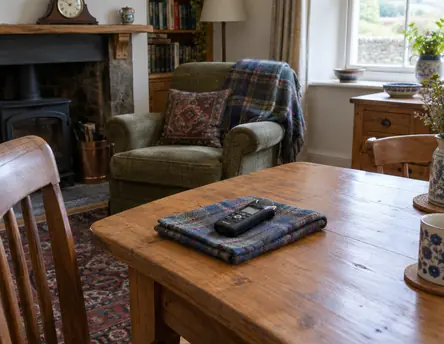
I allow 20-30 minutes before the session for consent confirmation, recorder setup, a headphone test, and documentation of the room, participants, and agreed access conditions. Separate audio tracks, or clearly logged time segments, keep the spoken introduction, the performance, and the post-performance explanation distinct. Before packing away, I record 30-60 seconds of room tone. Those seconds become the reference for hiss, clock bleed, and kettle noise when a catalogue user asks whether a click belongs to the singer or the house.
Twenty Quiet Minutes
Build the 20-30 minutes into the visit, not into the recorded hour. Consent confirmation, headphone check, and a written note of access conditions belong on the cloth beside the recorder, finished before the first sung line.
The voice-to-vault chain runs from spoken consent through Gaelic-first transcription, marked code-switches, dialect-preserving review, named attribution, and a returned community copy. Pròiseact nan Ealan work has long treated song, page, and spoken memory as one cultural fabric; the same discipline that public bilingual books such as Leabhar Mòr na Gàidhlig give to Gaelic text belongs in a kitchen-table recording. What follows maps that chain in field order, with timings taken from session practice rather than from a generic methods primer.
Talk Before the Form
Institutional ethics paperwork arrives as a dense block of clauses. Elders in Gaelic arts communities often meet that block as a barrier to speech. Reverse the paperwork instinct. Begin with a conversational explanation in the participant's preferred language, then use the institutional form to document what has already been discussed.
Work through recording, transcription, translation, quotation, online access, exhibition use, and teaching use as separate choices. Ask the participant to restate any restrictions in their own words, so the written record matches the spoken agreement. A single signature can close a form; it cannot, on its own, describe six different futures for the same file.
Hold the first consent conversation 5-10 days before recording. Reserve another 10-15 minutes on the day to confirm names, access categories, permitted uses, and the withdrawal route. Give the participant a bilingual one-page summary containing the researcher's contact details, intended archive destination, likely audiences, access status, quotation permissions, and the agreed method for requesting correction or withdrawal. The summary travels home in a pocket. The form stays in the project file.
Retention periods, destruction schedules, withdrawal deadlines, and available embargo lengths must follow the applicable university, archive, or heritage funder's approved policy. A fieldworker should not promise a duration that the eventual repository cannot administer. Name those limits in the sitting-room conversation, in ordinary sentences, after the host body has stated what it can actually keep.
The Oral History Society publishes ethics guidelines for oral history that sit usefully beside a bilingual summary sheet. Read them before the planning call, then leave the clause language at the door when the elder starts to talk.
Transcribe the Language Spoken
Scottish Gaelic interviews move. A speaker describing a waulking song or a dye recipe will shift into English for a workshop term, then back into Gaelic for a proverb, a place-name, or a line of puirt à beul. The recording captures that movement. The transcript has to keep it.
The transcriber first produces a time-coded record in the language actually spoken, retaining Gaelic passages as Gaelic and English passages as English. Code-switches are marked at the point they occur. A second pass checks names, song lines, specialist arts vocabulary, and dialect forms with the speaker or a competent regional-language reviewer. English translation begins only after that source transcript exists.
Insert timestamps at speaker changes and at intervals of 30-60 seconds. Mark switches with tags such as [Gàidhlig] and [English], and use [doilleir 00:18:42] for an unclear Gaelic passage requiring review. Regional dialect and idiom stay in the speaker's authentic voice. Standardized grammar can wait; for an arts archive it often never arrives, because the sung or spoken form is the evidence.
Budget approximately 6-10 working hours to transcribe and check one recorded hour containing natural bilingual conversation, followed by 2-4 additional hours for translation and comparison against the audio. That ratio is why a same-day English précis fails the collection. The Gaelic line, with its switches left visible, is the primary document. Translation is a service to later readers, authorized only where consent already named it.
Headroom for Sung Peaks
High-fidelity audio is what makes linguistic nuance and musical phrasing recoverable. Puirt à beul and waulking songs carry ornament, breath, and consonant detail that compressed formats smear. Speech and song also peak at different levels. A setting that looks safe for conversation will clip on a sustained note.
Listen to the room before choosing microphone position. Test speech near the participant, then test sung material again at a slightly greater distance to accommodate stronger peaks and sustained notes. In a community hall or active workshop, log noisy tools, heating systems, and conversations, then negotiate short recording windows around them. The log is part of the session record, not a private annoyance list.
Record spoken interviews as uncompressed WAV or Broadcast WAV at 24-bit/48 kHz. For detailed song or puirt à beul performance, 24-bit/96 kHz can be used when repository policy and storage capacity permit. Place a directional microphone approximately 20-30 centimetres from a seated speaker, use a windscreen, monitor through closed headphones, and aim for ordinary peaks around -18 to -12 dBFS while leaving headroom for singing.
Leave Phones Pocketed
Compressed smartphone audio will not stand as a permanent archival master. Use the phone for the planning call and for a backup slate if needed; keep the preservation track on a dedicated recorder writing uncompressed files.
In workshops, capture 30-60 seconds of each recurring sound separately and record a spoken slate identifying the room, microphone arrangement, and interruption before resuming the interview. Future listeners can then tell a dye-pot hiss from a heater cycle without guessing.
Credit Lines Speakers Choose
At the close of the interview, ask how the participant wishes to be named and whether a family, township, island community, ensemble, or workshop should also be credited. Those preferences become controlled metadata fields. They are not an informal thank-you added at publication. A proof transcript and proposed catalogue description then go back for correction.
A clean recording of a Hebridean song or dyeing demonstration does not make every detail public: the speaker's chosen credit line, access category and place-based restrictions define the archival boundary.
A full citation should include the participant's preferred name, role or art form, interview title, place, recording date, interviewer, language or languages, recording identifier, repository, access status, and the timecode for the quoted passage. Academic house styles can sit on top of that core while the community credit line remains the public name. Exhibition labels follow the same fields, shortened for wall length, never rewritten to flatten a township into an anonymous “local source.”
Return a review transcript within 14-30 days of transcription completion and allow a defined 10-21 day correction window before fixing the public catalogue description. After approval, provide copies of the recordings and transcripts to the interviewees and their families. Ownership of the narrative stays visible because the copy goes home as well as into the vault.
Restricted Consent Files
Prepare a preservation WAV, a smaller listening copy, the Gaelic-first transcript, the English translation where authorized, the signed consent record, a metadata sheet, and a SHA-256 checksum manifest. Keep consent files access-restricted rather than packaging them with public copies.
Dye-Pot Session, Call to Checksum
Here is a session you can copy. A researcher documents a Gaelic-speaking textile artist demonstrating a wool-dyeing process. During the planning call they decide that the recording needs three components: an oral account of how the process was learned, a narrated demonstration, and a close recording of Gaelic terms for materials, colour, and texture. The artist approves personal attribution and sets location restrictions on family-taught knowledge that must not be quoted without a further check.
| Stage | Timing | Action | Record produced |
|---|---|---|---|
| 1. Planning call | 10-14 days before | Confirm Gaelic or English preference, the dyeing stages to be demonstrated, hazardous or noisy tasks, attribution wording, location restrictions, and whether family-taught knowledge may be quoted. | Agreed scope notes |
| 2. Consent packet | 7-10 days before | Send the bilingual consent form and plain-language summary, then request questions or amendments no later than 2-3 days before travel. | Bilingual form and one-page summary |
| 3. Room and levels | Day of, first 25-35 minutes | Complete room assessment, microphone placement, level tests, file slating, and consent reconfirmation. | Slate, level test, confirmed consent |
| 4. Interview and demonstration | Day of, 75-105 minutes | Record the oral account of learning, the narrated dyeing demonstration, and the close recording of Gaelic terms for materials, colour, and texture. | Session WAV files in logged segments |
| 5. Dual copy | Within 24-48 hours | Copy the original files to two separate storage locations, generate checksums, and preserve the recorder card until both copies have been opened and verified. | Dual copies and SHA-256 manifest |
| 6. Gaelic-first transcript | Within 7-14 days | Prepare the time-coded source transcript in the language spoken, with [Gàidhlig] and [English] tags at each switch. | Gaelic-first transcript |
| 7. Translation and review | Following 7-14 days | Complete the checked translation and descriptive metadata, then send the review package to the artist for the 10-21 day correction window. | Review package returned to the artist |
- Make the planning call 10-14 days before the visit. Confirm language preference, demonstration stages, hazardous or noisy tasks, attribution wording, location restrictions, and whether family-taught knowledge may be quoted. Write those decisions into the scope notes before anyone travels.
- Send the bilingual consent form and plain-language summary 7-10 days before fieldwork. Ask for questions or amendments no later than 2-3 days before travel, so the day-of conversation only confirms, rather than renegotiates, the uses.
- On the day, reserve 25-35 minutes for room assessment, microphone placement, level tests, file slating, and consent reconfirmation. Place the directional microphone 20-30 centimetres from the seated artist, windscreen on, headphones closed, ordinary speech peaking around -18 to -12 dBFS. If a pot will hiss or a burner will click, capture 30-60 seconds of that sound on its own and slate the interruption.
- Run a 75-105 minute interview and demonstration in three logged segments: how the process was learned; the narrated dye stages; the Gaelic lexicon for wool, colour, and texture. Record 30-60 seconds of room tone before packing away.
- Within 24-48 hours, copy the original files to two separate storage locations, generate checksums, and leave the recorder card untouched until both copies have been opened and verified.
- Within 7-14 days, prepare the Gaelic-first transcript with timestamps at speaker changes and every 30-60 seconds. Complete the checked translation and descriptive metadata in the following 7-14 days. Send the review package to the artist, wait the defined 10-21 day correction window, then lock the catalogue line with her chosen name, mark the location restriction in the access field, store the consent sheet apart from the public listening copy, and file the SHA-256 manifest beside the preservation WAV.
Once the artist returns the marked transcript, enter her preferred credit as the controlled name, keep the family-taught passages in the restricted access category she named on the one-page summary, and deliver her listening copy and Gaelic-first transcript to the household before the public catalogue goes live.