Sequamur: Exploring Gaelic Drama and the First World War
This article examines the Gaelic play Sequamur, exploring its portrayal of the First World War, cultural impact, and historical context in Scotland.
Executive Summary
The title Sequamur translates from Latin as 'Let us follow'. It serves as the historic motto for the Nicolson Institute in Stornoway, providing the primary interpretive anchor for this Gaelic play. The production operates strictly as a local memory piece rather than a sweeping military survey. It grounds the trauma of the First World War firmly within the walls of a specific secondary school.
The historical window of the narrative opens on 4 August 1914 and formally closes on 11 November 1918. The grief of the Lewis community, however, extends into 1 January 1919. The homecoming shipwreck of the Iolaire near Stornoway Harbour shattered the island just as peace seemed secure. By linking education, civic duty, and the Scottish Gaelic language, the production examines how a single institution processed an unprecedented scale of loss.
Historical Context of Sequamur
To understand the dramatic weight of the text, we must trace the geography of the loss. The narrative builds outward from the Isle of Lewis to the port of Stornoway, settling finally on the Nicolson Institute. W.J. Gibson held the headship here from 1894 to 1925. He shaped a generation of pupils through a distinct educational philosophy rooted in late Victorian ideals of service. When the United Kingdom entered the conflict on 4 August 1914, that philosophy of duty met a brutal reality.
Local commemorative accounts record that more than 6,000 men from Lewis served during the war. Over 1,000 of those men died. The pressure placed on Gaelic-speaking families was immense. The tragedy of the trenches compounded with the localized devastation of the 1 January 1919 shipwreck, which killed at least 200 men at the very entrance to Stornoway Harbour.
Key Takeaway: The play's emotional core relies on the tension between Gibson's classroom ideals and the casualty lists that decimated his student body.
Theatrical Representation of Trauma
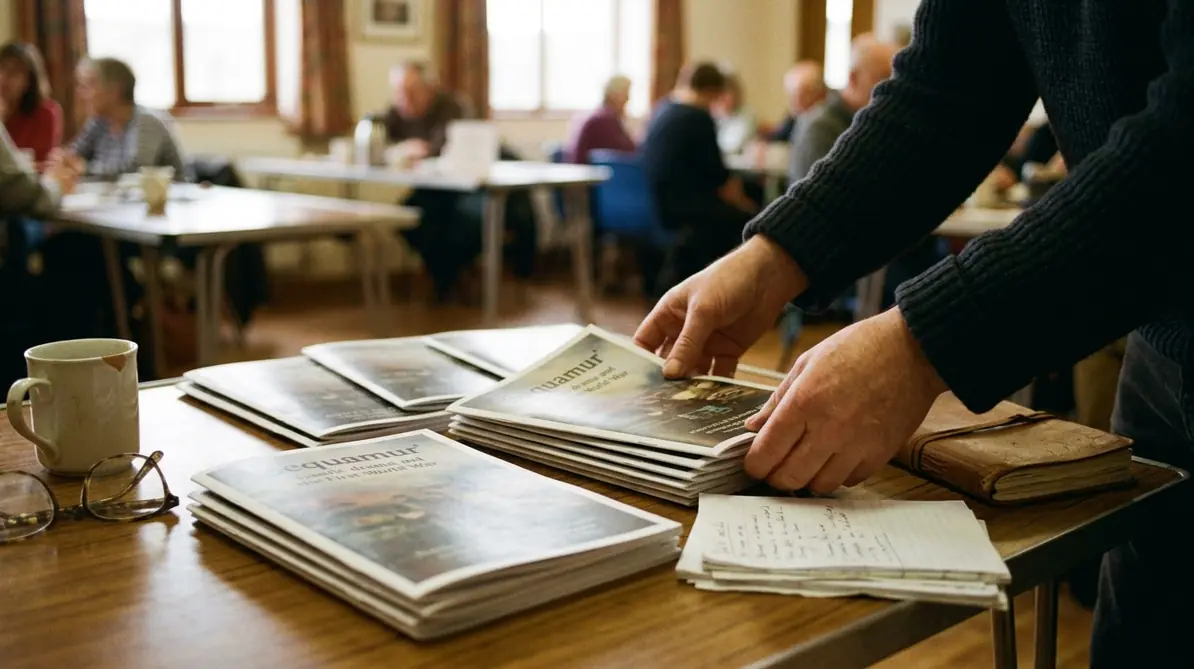
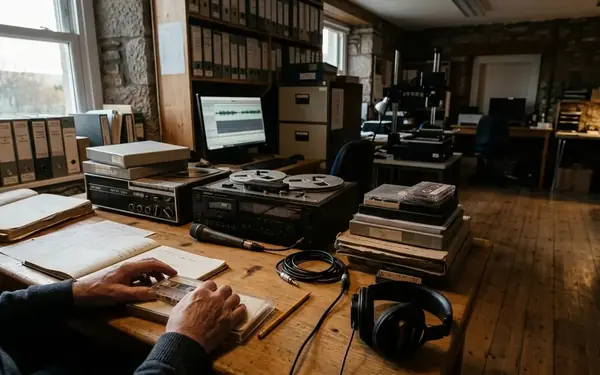
The production stages a continuous spatial negotiation. Directors move the cast between the disciplined, structured space of the Stornoway classroom and the exposed, chaotic military front overseas. Archival script directions and production photographs reveal a heavy reliance on sound cues, lighting shifts, and roll-call structures to bridge this gap. The transition from school desk to the front line is strictly tied to the 1914-1918 service period, anchoring the trauma in a specific chronological reality rather than a timeless abstraction.
The use of Scottish Gaelic roots the emotional resonance in specific cultural markers. Rather than relying on a generalized sense of sorrow, the script deploys concrete textual features. We hear kinship terms, localized prayers, untranslated phrases, and traditional laments.
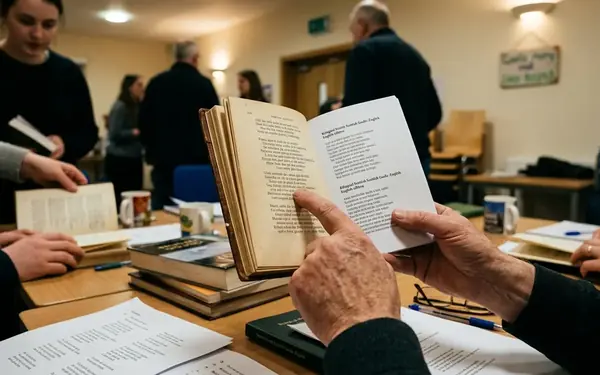
When examining the English surtitles provided in programme notes, we see the friction of translation. A Gaelic phrase carrying deep ancestral weight often softens into a standard English expression of grief. This comparison demonstrates exactly what cultural meaning is retained, softened, or lost across the language barrier.
Scope and Limitations of Archival Drama
Adapting fragmented historical records into a cohesive dramatic narrative requires careful categorization of evidence. As analysts, we must separate documented history from archival inference and theatrical invention. Documented history provides our fixed points: the dates of 4 August 1914, 11 November 1918, and 1 January 1919, alongside verifiable school registers and memorial rolls.
Archival inference allows us to connect Gibson's educational philosophy to the later enlistment decisions of former pupils. We draw these links only when supported by contemporary letters, school magazines, speeches, or recorded reminiscences. Theatrical invention fills the remaining gaps. The play uses composite characters, imagined dialogue, and compressed chronologies to maintain narrative momentum.
Engagement metrics indicate a profound audience response to these staging techniques. We can make firm claims about the play's historical accuracy only where the script and production archive align directly with primary source documentation.
Warning: A single production cannot represent every Lewis household affected between 1914 and early 1919. Treating the play as an exhaustive account of the island's wartime experience misinterprets its dramatic function.
Cultural Impact and Legacy
The legacy of Sequamur extends well beyond its initial run. Its afterlife exists in performance documentation, education packs, and the ongoing transmission of Gaelic culture. Commissioning history places the production squarely within the 2014-2018 commemoration cycle. This period generated renewed institutional attention toward Gaelic-language treatments of wartime memory.
Educators now pair the play text with school registers, local memorial rolls, and maps of Stornoway to teach Celtic heritage. A practical teaching structure divides the material into three distinct blocks:
A 45 to 75-minute session focused on historical context, using resources like the National Library of Scotland First World War archives.
A 45 to 75-minute session dedicated to Gaelic language and translation mechanics.
A final 45 to 75-minute session comparing script scenes directly with archival evidence.
Beneficiary reporting confirms that this structured approach grounds the theatrical experience in verifiable local history. By commissioning and studying Gaelic-language works, we document national history through the exact linguistic lens of those who lived it.