Bringing Caimbeul’s Gaelic Voice into Live Performance
Adapting Shrapnel for the stage puts the language itself at stake. Strip Tormod Caimbeul’s prose down to plot and the adaptation risks losing the idiomatic texture that gives its voices their force. Carry too much prose across unchanged and live action can struggle beneath the weight of explanation. The central question concerns what an audience can hear, follow and feel while the performance keeps moving.
A strong reading of Theatre gu Leòr’s production locates its achievement in a sonic and physical distillation of the novel’s dark humour and fractured narrative, rather than a literal transcription. Three accomplishments would support that reading: preserving the Lewis Gaelic register, providing bilingual access within the scenic world, and creating a touring production that could work across contrasting venues.
Available documentation treats these as propositions to investigate, not confirmed production outcomes. While Catriona Lexy Campbell is credited as the adapter, a programme or published script confirming the credit is required alongside a verifiable first-to-final performance date range. Those records matter because an account of artistic intention, a reconstruction of production practice and a judgement about reception require different evidence.
A useful case study can nevertheless establish the route through that evidence. The script must show what happened to Caimbeul’s language. Access documentation must establish how audiences encountered any accompanying English. Touring records must demonstrate what travelled and what changed between venues. Keeping those strands separate gives future Gaelic adaptations a more practical foundation than an unqualified success story.
Following the Novel’s Fractured Sequence
Shrapnel is a darkly comic noir whose eccentric voices, interior speech and shifting temporal layers resist straightforward compression. That structure sets the reading task. A close comparison must establish where the novel places each incident, who narrates it and what the stage version asks an audience to understand at that moment.
Chronology alone offers a narrow measure of clarity. A delayed disclosure may shape suspicion; a digression may establish the speaker’s social world; a repeated phrase may acquire comic pressure through its return. Moving such material into chronological order could make events easier to recount while changing the experience of hearing them. For this production, that argument needs an actual reordered episode before it can become a finding.
Separate Moving, Cutting and Reassigning
Three textual operations deserve separate records. Moving an episode changes its position. Cutting a passage removes material. Transferring speech changes the person who carries it. Each can alter the dramatic meaning of a passage even when the surviving Gaelic remains close to the source.
- Locate the passage. Record the named edition of the novel, its page reference and the corresponding script scene and page.
- Identify the voice. Distinguish the narrator’s language from dialogue spoken by a character.
- Track the operation. Mark a relocation, deletion or reassignment separately, including cases where several operations affect the same passage.
- Describe the consequence. Explain what the audience learns earlier, hears differently or must infer through action.
This approach also sharpens the question of ensemble size. An economically manageable touring cast may require substantial redistribution of a novel’s voices. The useful comparison asks which distinctions survive that redistribution: social register, verbal habit, relationship and perspective. Counting retained characters alone cannot answer it.
The first substantial finding should therefore be small and exact: a passage, its original speaker or narrator, its stage destination and the change in dramatic function. That provides firmer ground than describing the whole adaptation as faithful.
Reconstructing Campbell’s Script Decisions
Character consolidation and multi-roling solve different problems. Consolidation combines source characters into a stage character. Multi-roling assigns several characters to a performer. A compact cast could use either technique, both techniques or neither; its size alone establishes very little about the adaptation.
For the adaptation attributed to Catriona Lexy Campbell, the first comparison should place the novel’s named characters beside the script’s dramatis personae and the programme’s performer credits. That would establish which voices remain distinct and which performers carry them. Only then could an analysis explain how vocal rhythm, posture or movement differentiates those roles in performance.
Follow a Revision Through Its Records
A dated early script and a dated later script can establish that wording changed. They cannot, by themselves, explain the change. An annotated rehearsal copy, design note or attributable interview may supply the missing reason: a difficult transition, an unclear relationship, a cue that interrupted speech, or another documented concern.
Any account of the workshop process needs this chain of evidence. Without it, claims that playwright, director and Gaelic-speaking performers collectively tested and refined the text remain research questions. No workshop duration or rehearsal schedule can be inferred from the finished script.
The distinction is especially important when assessing idiom. A shorter line may preserve a speaker’s colloquial edge; it may also remove the phrase that locates the voice socially or geographically. Reading both versions aloud offers a useful analytical exercise, but evidence that the production team performed that exercise must come from the development record.
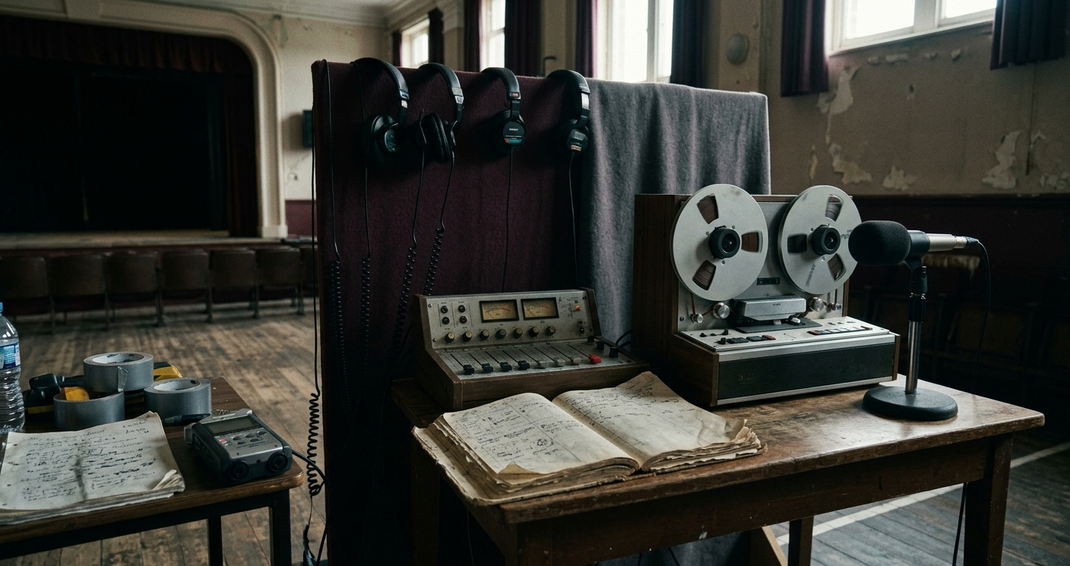
The voice-transfer breakdown follows a clear sequence: Caimbeul’s narrator or character, the adapter’s assigned speaker, the performer’s delivery, and any accompanying English projection. At every boundary, the study should record what remains, what changes and what evidence supports the account.
This sequence reveals why textual fidelity needs close attention. Identical words can perform a different function when another character speaks them. A sentence that offers narrative distance on the page may become an accusation, confession or joke in dialogue. The analysis should identify the function demonstrated by the particular passage rather than assume that retained wording preserves the original relationship.
Keeping Gaelic Speech and English Access in View
Before judging whether access preserved scenic immersion, establish what the production actually offered. Translated surtitles, creative captioning and visual storytelling describe different practices. Continuous English translation asks an audience to divide attention differently from selective text embedded in a visual composition. Gesture and spatial relationships can clarify action without providing a verbal translation at all.
The supplied material does not document which of these approaches Theatre gu Leòr used. Performance footage, projection files, cue lists and design statements would allow the case study to identify the format, then examine its effect.
Pair a Gaelic Utterance with Its Cue
The most revealing unit of analysis is a particular exchange. Record the Gaelic utterance, any displayed English wording, the projection location and the point at which the text appears. Then examine what the spectator must do: look away from the speaker, read ahead of a response, or connect a brief text cue with an unfolding action.
This is the Lewis-Gaelic-to-projection boundary. Preserving idiomatic speech and making translated text readable are distinct design tasks. A translation can communicate the event while losing an implication carried by register. A carefully chosen phrase can still fail as access if spectators cannot read it from their seats.
Protect the Spoken Cue
Test the English text against the Gaelic exchange it accompanies. Where a joke or disclosure depends on timing, the projection cue should enter the analysis alongside the performer’s delivery. The record needs to show whether the audience receives information before, during or after the spoken turn.
Physical staging requires the same specificity. To assess the proposed shadowy, surreal atmosphere, identify a documented scenic arrangement, lighting transition or movement sequence and explain its relationship to the text. A production photograph may show a visual composition. It cannot establish how that composition developed over time or whether projected language remained legible throughout the auditorium.
Claims about rapid-fire delivery need a recorded exchange or an attributable performance account. The principle behind prioritising linguistic rhythm is clear: fluent speakers should be able to encounter the Gaelic at its full dramatic pace. Whether this production achieved that balance must emerge from the relationship between speech, movement and access cues.
Testing the Production Across Touring Venues
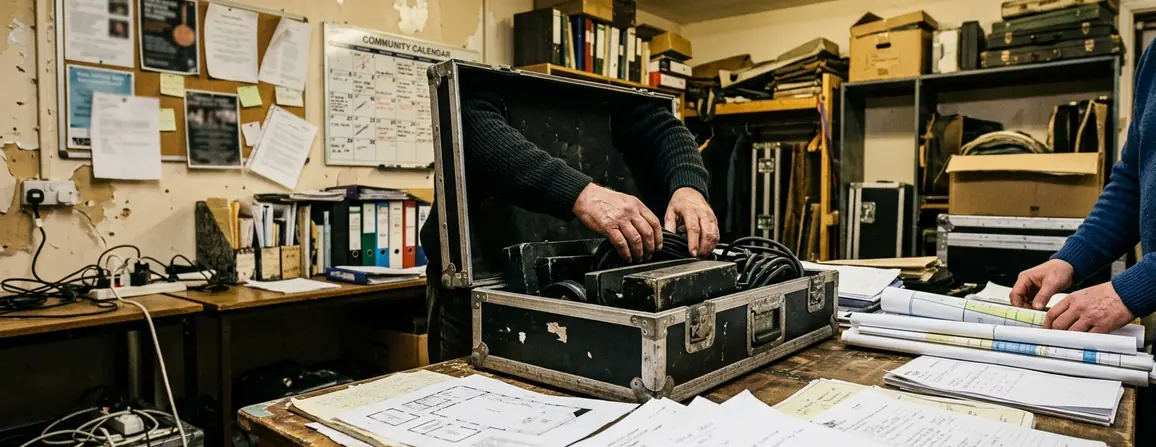
A touring design proves its adaptability through documented configurations. A technical rider describes requirements; a venue plan shows the available space; a performance record helps establish what the company actually used. Reading those documents together can reveal the practical relationship between the intended production and each local arrangement.
The outline proposes a comparison between urban studio theatres and Highland and Island community halls. No dated venue list accompanies it, so the route cannot responsibly be narrated as established history. The case study should begin with verified stops and retain each venue’s specific conditions.
Record the Room Before Comparing It
- Performance and venue: establish the date, venue type and available playing area.
- Scenic arrangement: identify what occupied the floor and how the layout related to entrances, seating and movement.
- Projection provision: record the projector position, display surface, operator position and relevant audience sightlines.
- Sound and lighting: distinguish equipment supplied by the company from equipment supplied locally.
- Working schedule: report get-in and get-out durations only where schedules or crew records support them.
A change in projection position between documented venues could demonstrate an accommodation to the room. It would not establish that the designers anticipated that change before rehearsals. Linking touring adjustments to the original scenic footprint requires design notes or testimony. That distinction protects a useful operational lesson from becoming an invented account of foresight.
Audience comparison also needs a narrower lens than the familiar heartland-versus-city contrast. A dated review describing recognition of a local idiom provides evidence about that performance. A city review concentrating on theatrical form records another response. Neither establishes what all Gaelic-speaking communities or all urban audiences valued.
Venue-specific evidence can still be rich. It may connect a particular line with reported laughter, a projection arrangement with a sightline concern, or a scenic adjustment with the room’s dimensions. Those observations make the tour legible as a series of working environments, each with its own demands on language and attention.
For Gaelic cultural infrastructure, this level of detail has lasting value. A hall’s contribution to a production becomes visible through the conditions it provides for speech, access, performance and gathering.
Building a Traceable Model for Gaelic Prose on Stage
Future adaptations need examples that another creative team can examine. A retained idiom becomes useful evidence when its dramatic function is clear. A cut becomes instructive when the record shows the action it enabled. An access cue becomes transferable practice when its rehearsal history explains how the team developed it.
The following comparison keeps literary and theatrical questions connected without treating either as a single measure of fidelity.
| Source passage | Stage treatment | Documented rationale | Observable consequence |
|---|---|---|---|
| An idiom in its narrative or conversational setting | Retention, revision or reassignment | A script annotation or attributable explanation | The function it performs in the recorded exchange |
| A passage omitted from the stage script | The cut and any redistributed information | A dated development record | The transition or action that follows |
| A Gaelic exchange requiring audience access | Documented English text or another access treatment | A rehearsal cue sheet or design record | The relationship between reading, listening and watching |
Bring Access into Script Development
An implementable process begins while the script can still change. Identify exchanges whose timing depends on withheld information. Draft accompanying English alongside those exchanges. Test where spectators look, when they finish reading and what they can hear while doing so. Retain dated versions of the text and cues, so the eventual production account can distinguish an early access decision from a late adjustment.
These are proposed working steps for future teams. Establishing that Shrapnel followed them would require a projection draft, rehearsal cue sheet or design meeting record preceding its first performance.
Archive research should keep production evidence beside literary evidence. The National Library of Scotland Gaelic theatre collections offer a starting point for enquiries into relevant holdings; the link itself does not establish that any particular Shrapnel document survives there. A reliable case study would cite the actual edition, programme, script version and performance record it consulted.
The strongest eventual verdict will emerge from those specific connections: language to speaker, speaker to body, body to room. Even a compact cast demands an exact vocabulary. One performer playing several characters establishes multi-roling; several source characters becoming a single stage character establishes consolidation.